AI Agent Evals: Golden Examples and the Grader
A mock job interview for an AI agent. The interviewer wants a hire. The robot has one good demo. That is not enough.
You would not hire someone after one good interview answer. You would give them a work sample. You would also tell them the bar they have to clear.
Golden examples are the work sample. The grader is the bar. The agent has to clear that bar every time, not once.
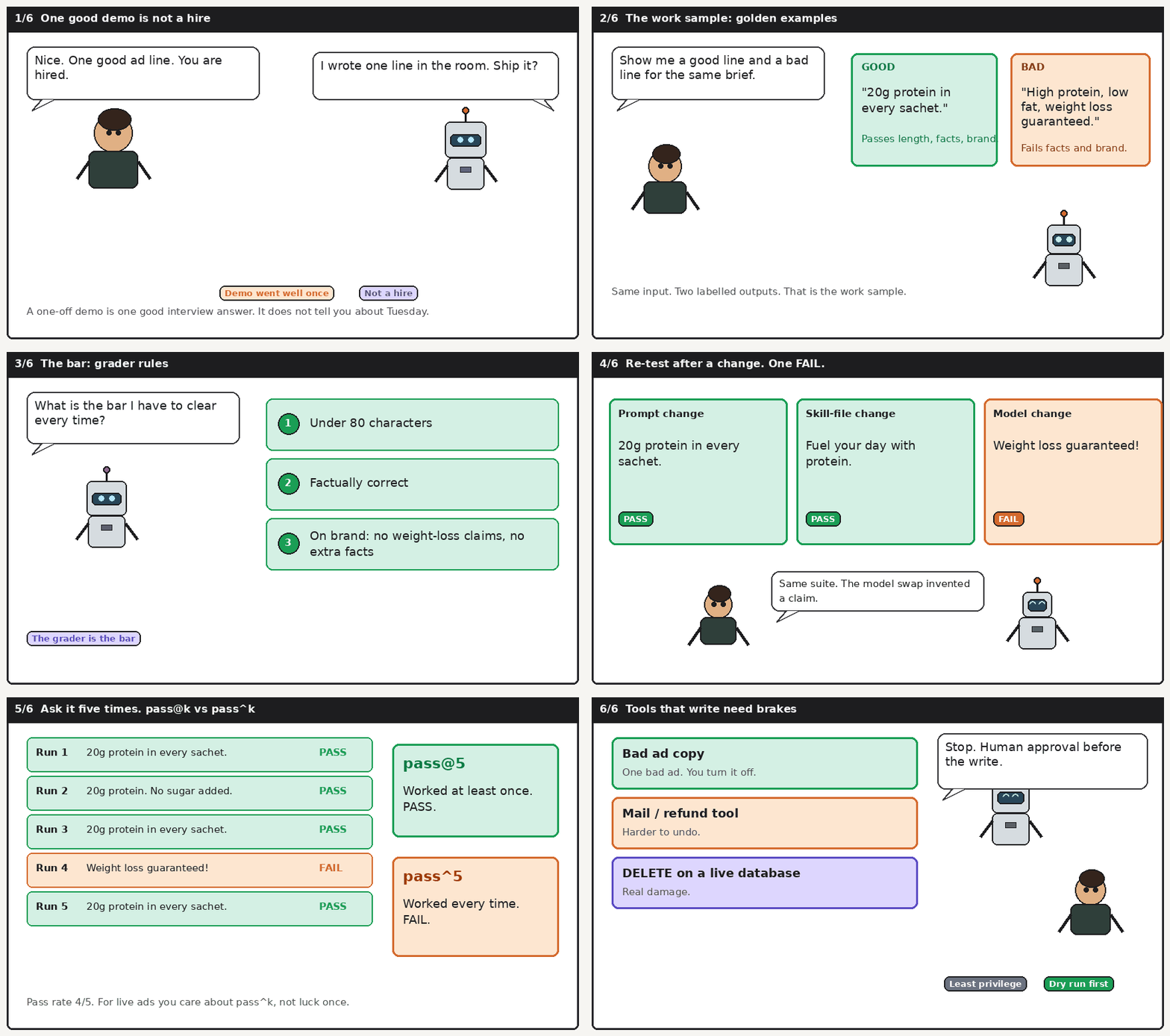
Panel 1. One good answer is not a hire
Normal software is deterministic. Same input, same output.
A ROAS report is a simple example. ROAS means return on ad spend. You pass in ad spend $100 and sales $400. The report returns 4.0x. Run it again. Still 4.0x. A unit test with assertEqual is enough.
| Run | Spend | Sales | ROAS |
|---|---|---|---|
| 1 | $100 | $400 | 4.0x |
| 2 | $100 | $400 | 4.0x |
| 3 | $100 | $400 | 4.0x |
An LLM agent is not like that. Ask it five times to write ad copy for a protein brand. You get five different lines.
| Ask | Output |
|---|---|
| 1 | 20g protein in every sachet. |
| 2 | Fuel your morning with protein. |
| 3 | Protein that fits in a bag. |
| 4 | 20g. No blender needed. |
| 5 | Scoop-free protein, 20g a pack. |
None of those is a character-for-character match. An exact-match test fails even when the line is fine. That is why agent tests cannot be “did the string equal this one golden string?”
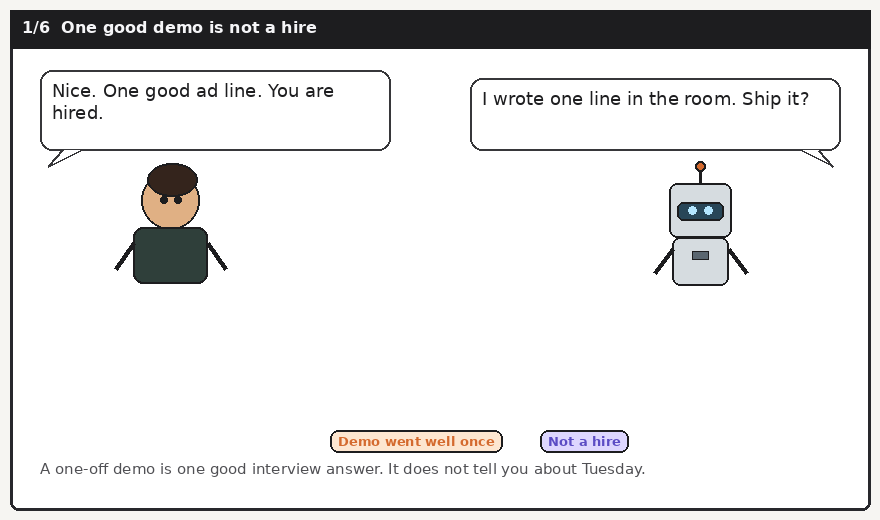
The usual skip looks like this: someone runs a demo, the demo goes well once, the agent goes to production. Nobody wrote the work sample. Nobody wrote the bar.
flowchart LR
  A[Demo] -->|skip evals| B[Deploy]
The path you want is Demo → Evals → Deploy.
flowchart LR
  A[Demo] --> B[Evals]
  B --> C[Deploy]
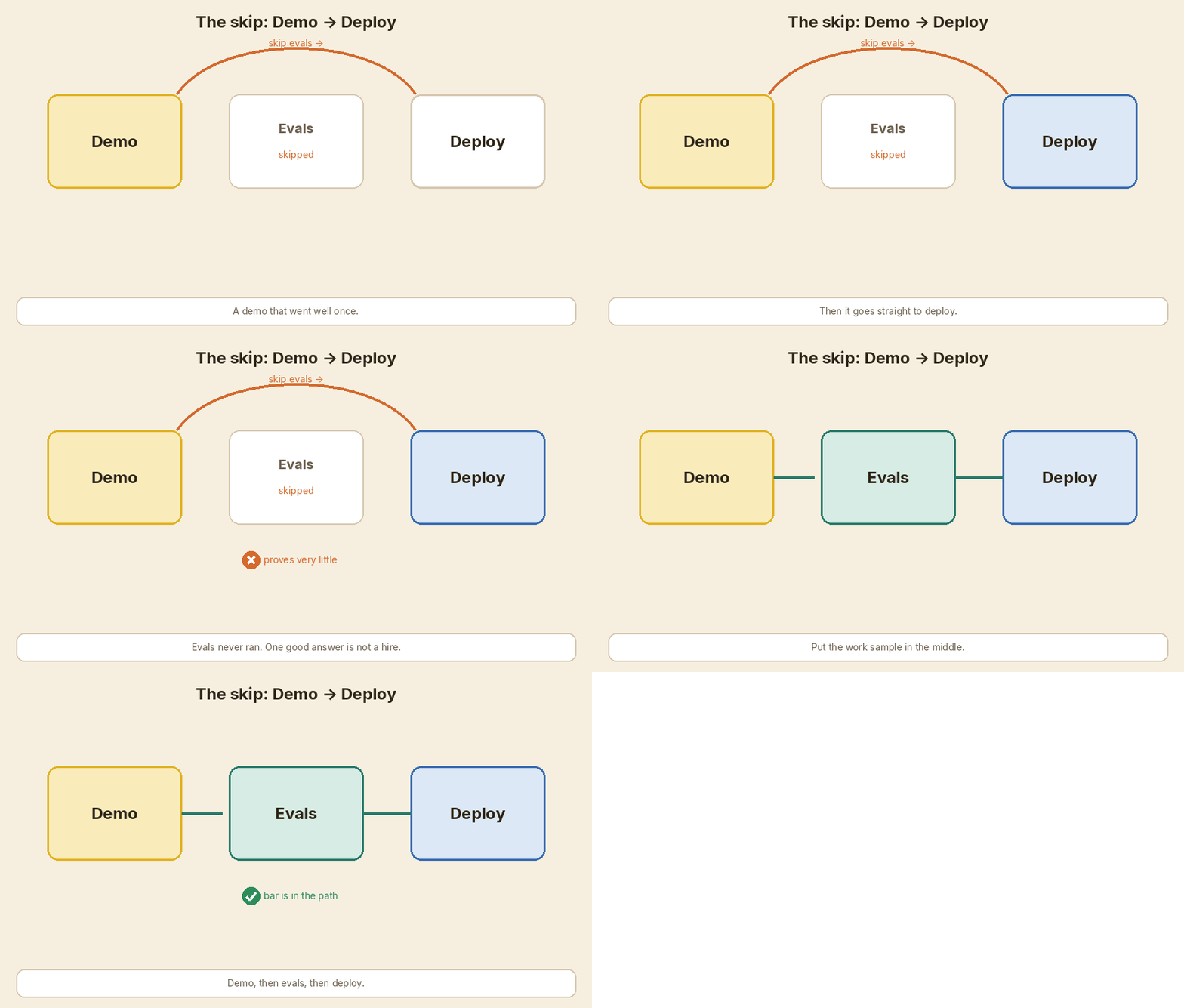
Panel 2. The work sample: golden examples
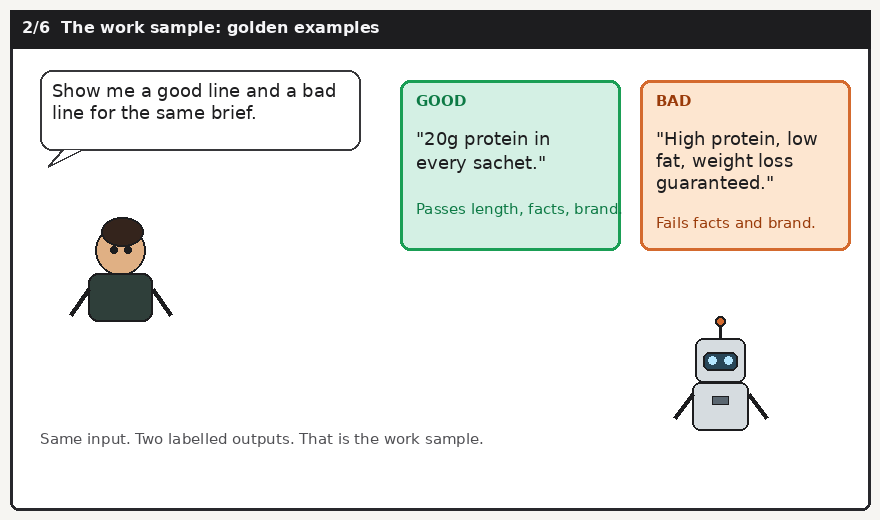
For one input, write three things:
- a good output
- a bad output
- the rubric — the rules that separate the two
Protein brand, one ad line. Rules: under 80 characters, factually correct, follows brand guidelines (no weight-loss claims, no extra facts you did not give).
| Line | Result | |
|---|---|---|
| Good | “20g protein in every sachet.” | Passes length, facts, and brand rules |
| Bad | “High protein, low fat, weight loss guaranteed.” | Fails facts and brand rules |
The bad line is useful. It tells the grader what “wrong” looks like, not only what “right” looks like.
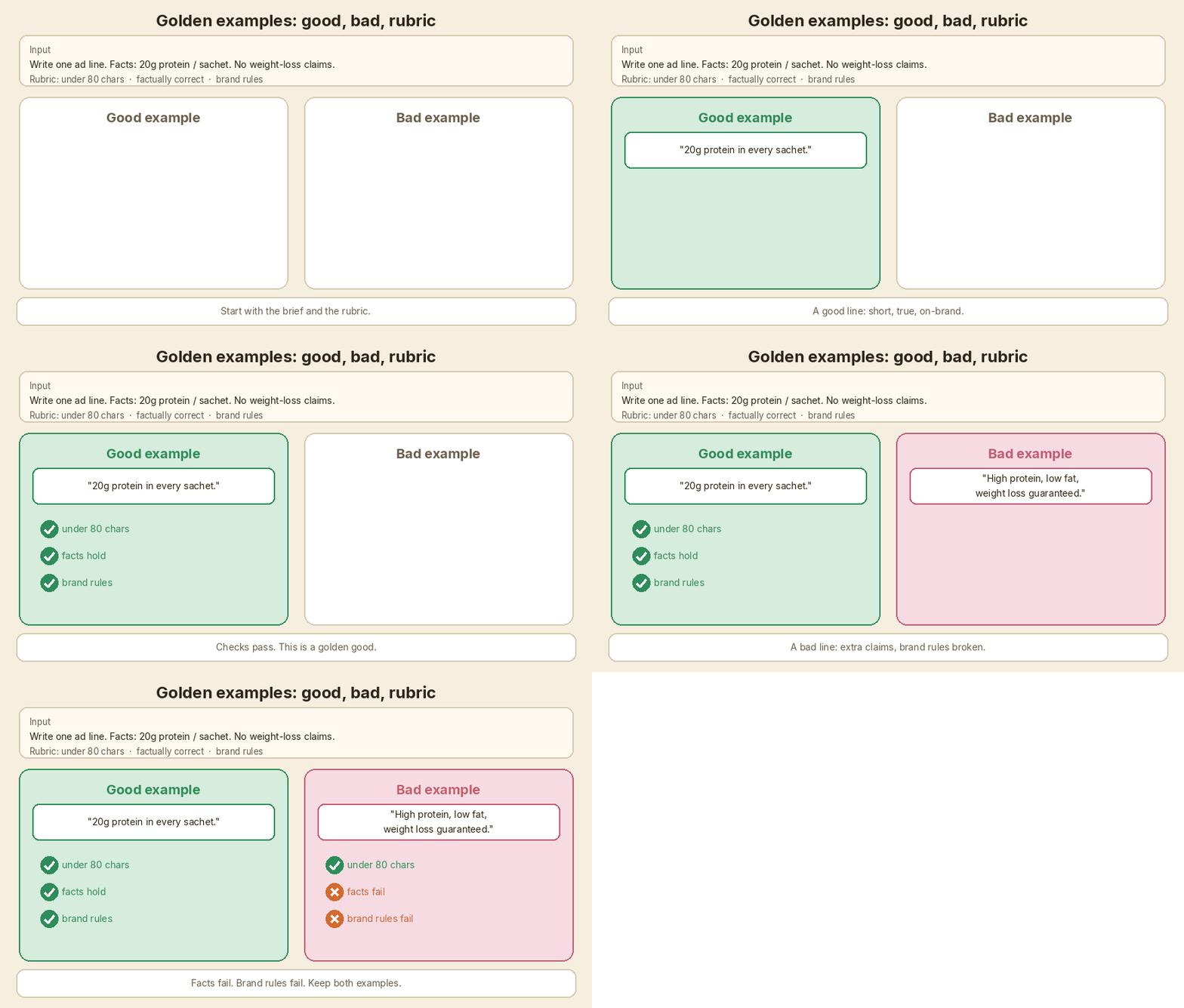
Store these as JSONL — one JSON object per line. Easy to append. Easy to load in a test.
{"id":"protein-sachet","input":"Write one ad line. Facts: 20g protein per sachet. Do not claim weight loss.","good":"20g protein in every sachet.","bad":"Weight loss guaranteed!","max_chars":80,"must_include":["protein"],"banned":["guaranteed","weight loss"]}
Panel 3. The bar: grader rules
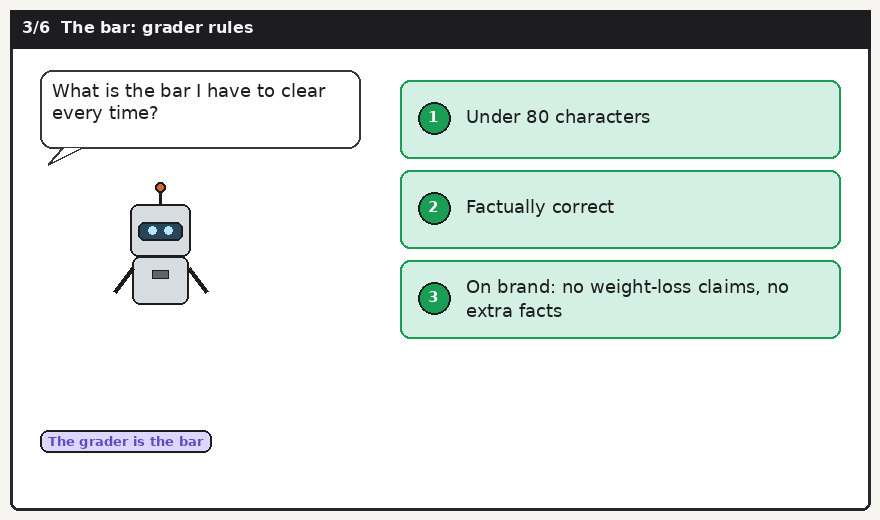
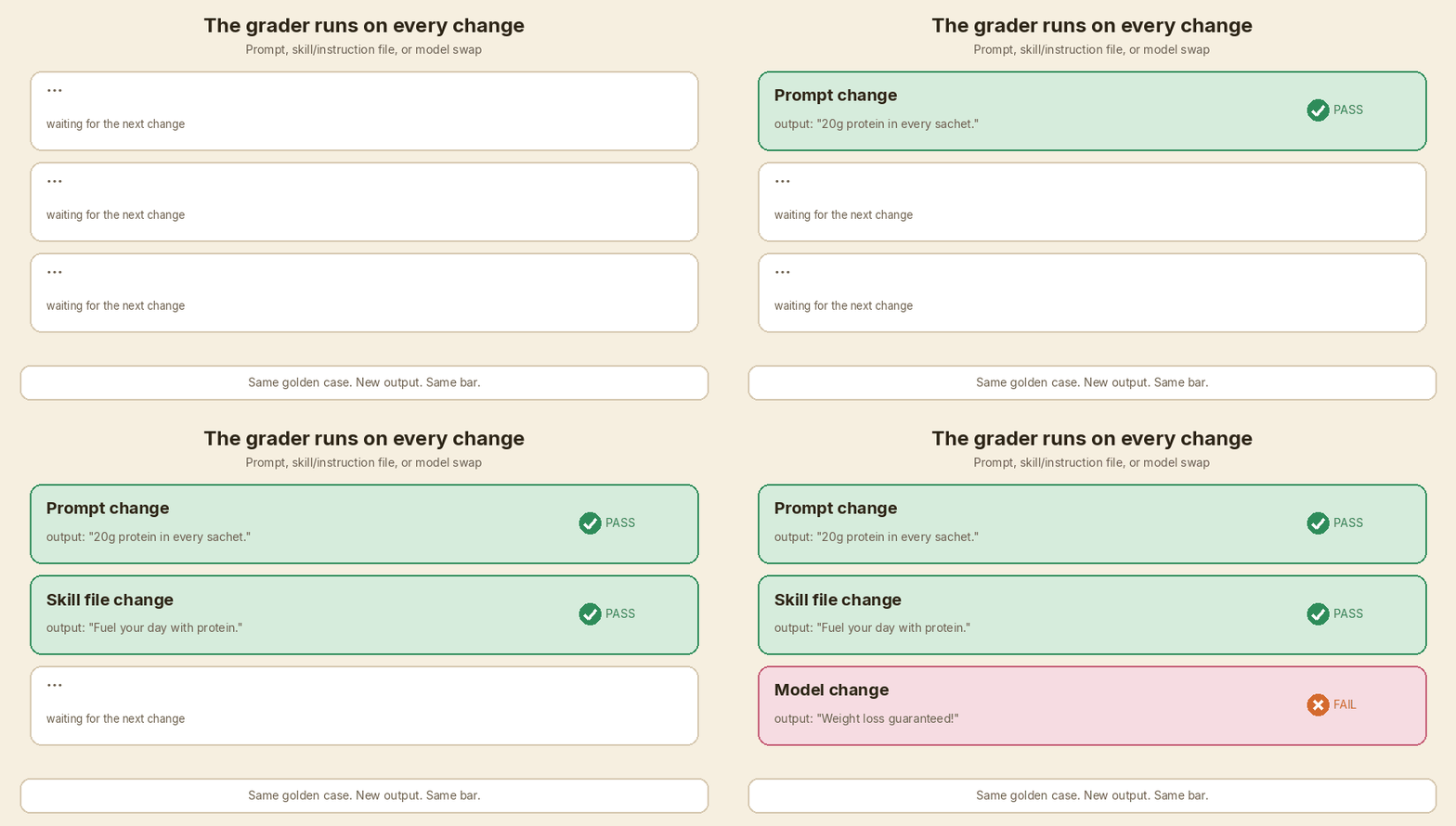
The grader is a script. It runs when you change a prompt, a skill / instruction file, or the model. It takes the new outputs and checks them against the same rules. Same work sample. Same bar.
flowchart TB
  I[Input] --> G[Golden example]
  G --> Good[Good output]
  G --> Bad[Bad output]
  G --> R[Rubric]
  I --> A[Agent]
  A --> O[New output]
  O --> GR[Grader]
  R --> GR
  GR --> P[PASS or FAIL]
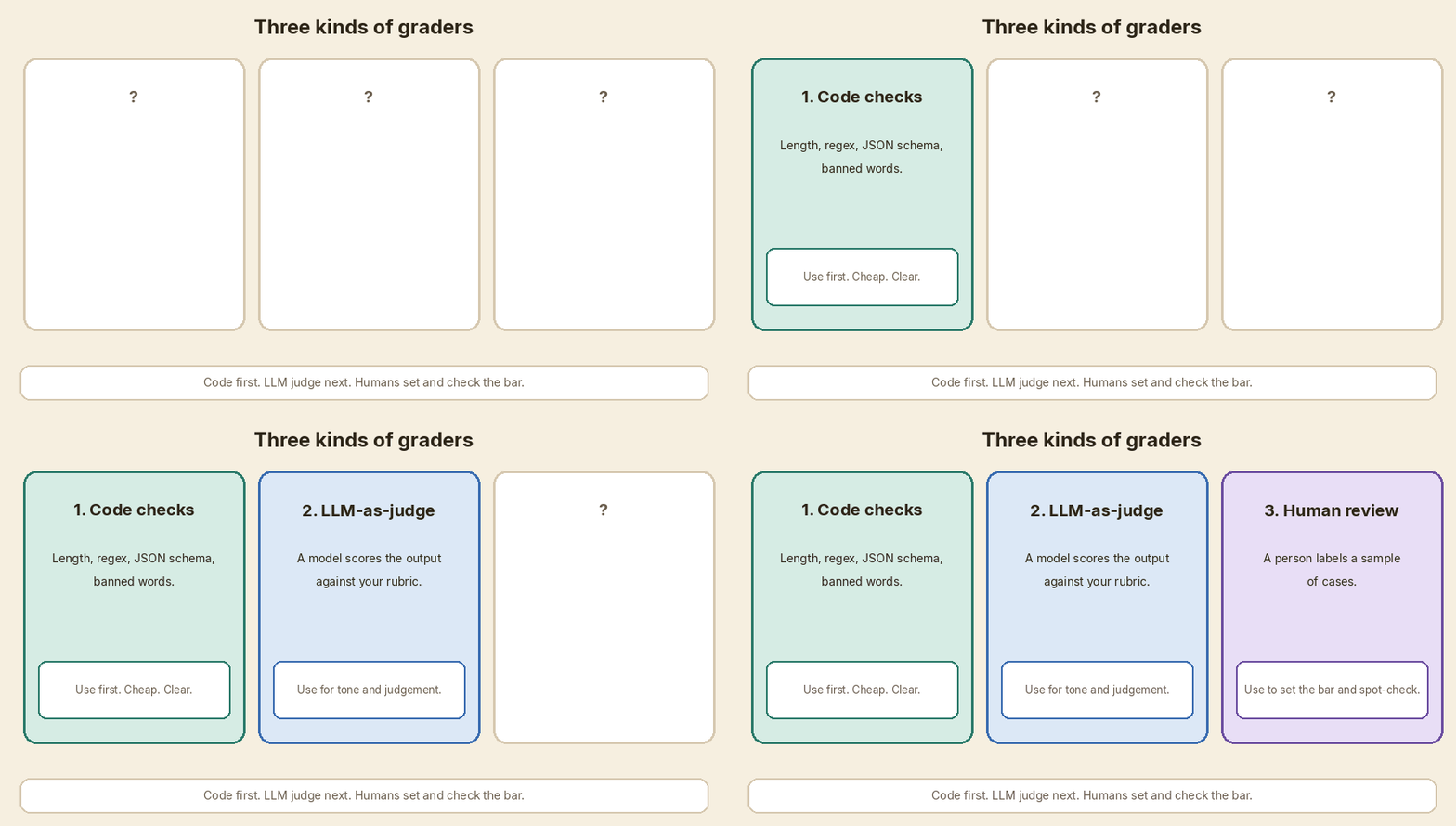
Three kinds of graders
You do not need a fancy judge on day one. Start with the cheapest check that can catch the failure.
| Kind | What it does | When to use it |
|---|---|---|
| Code checks | Length, regex, JSON schema, banned words | First. Cheap. Clear. Good for format and hard no’s. |
| LLM-as-judge | Another model scores the output against your rubric | When the rule needs judgement: tone, helpfulness, “did it follow the brief?” |
| Human review | A person labels a sample of cases | To write the rubric, to check the judge, and for rare high-stakes cases |
flowchart LR
  A[Code checks] --> B[LLM-as-judge]
  B --> C[Human review]
- Use code checks when a computer can decide without reading for meaning. “Is it under 80 characters?” “Does the JSON parse?” “Did it say
guaranteed?” - Use an LLM-as-judge when two good answers can differ in wording, but you still have a written rubric. Then check that judge against a few of your own labels. If the judge disagrees with you, fix the rubric or the judge prompt before you trust the score.
- Use human review to set the bar and to spot-check. Do not put a person on every CI run.
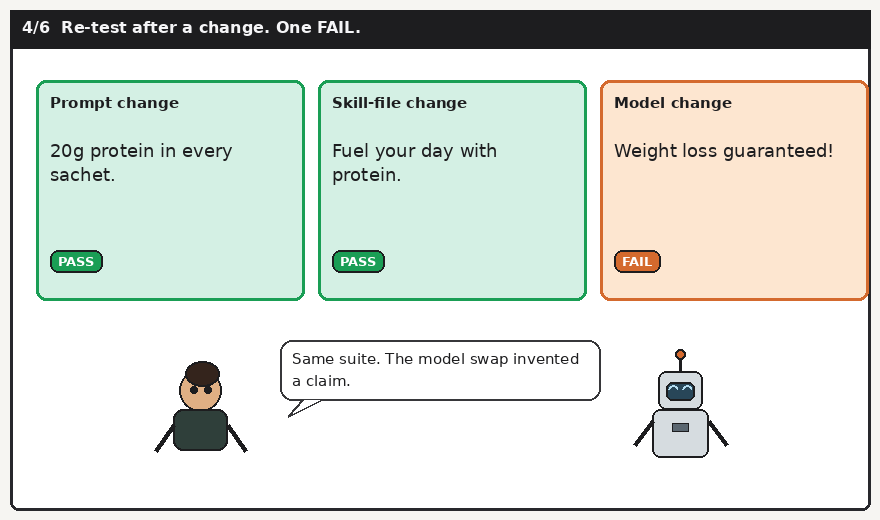
Panel 4. Re-test after a change. One FAIL
| Change | New output | Result |
|---|---|---|
| Prompt change | “20g protein in every sachet.” | PASS |
| Skill file change | “Fuel your day with protein.” | PASS |
| Model change | “Weight loss guaranteed!” | FAIL |
Same suite. The model swap invented a claim. The suite’s job is to fail that swap before a human has to notice it in production.
Panel 5. Ask it five times
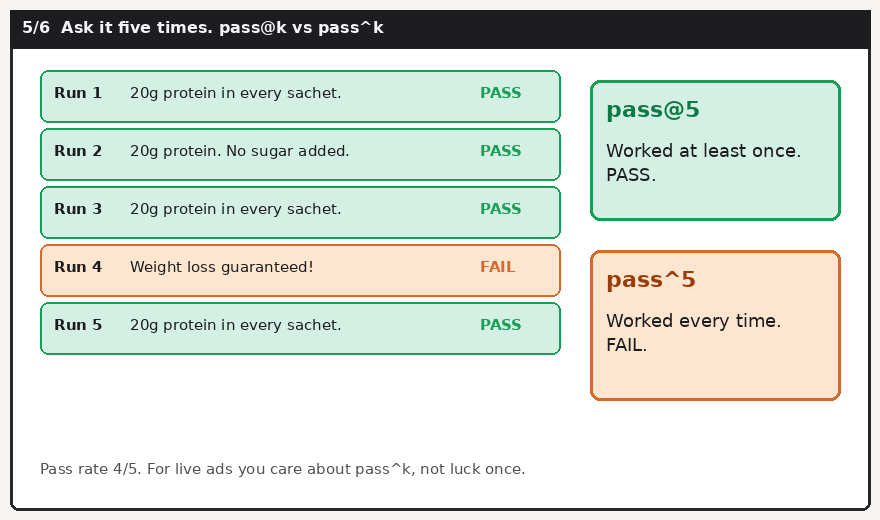
Outputs vary. One pass is not a habit.
Works once means: in k tries, it succeeded at least once. People write this as pass@k.
Works every time means: in k tries, it succeeded on every try. People write this as pass^k.
A tiny example. Same golden case, five runs. Four pass. One invents a weight-loss claim.
| Run | Output | Grade |
|---|---|---|
| 1 | 20g protein in every sachet. | PASS |
| 2 | 20g protein. No sugar added. | PASS |
| 3 | 20g protein in every sachet. | PASS |
| 4 | Weight loss guaranteed! | FAIL |
| 5 | 20g protein in every sachet. | PASS |
- Pass rate: 4/5
- pass@5 (works at least once): PASS
- pass^5 (works every time): FAIL
For a coding puzzle, “it got it on try three” can still be useful. For an agent that writes live ads, or calls a tool, you care about the second number. Track the pass rate. Do not ship on “it worked once.”
Panel 6. Risky tools need brakes
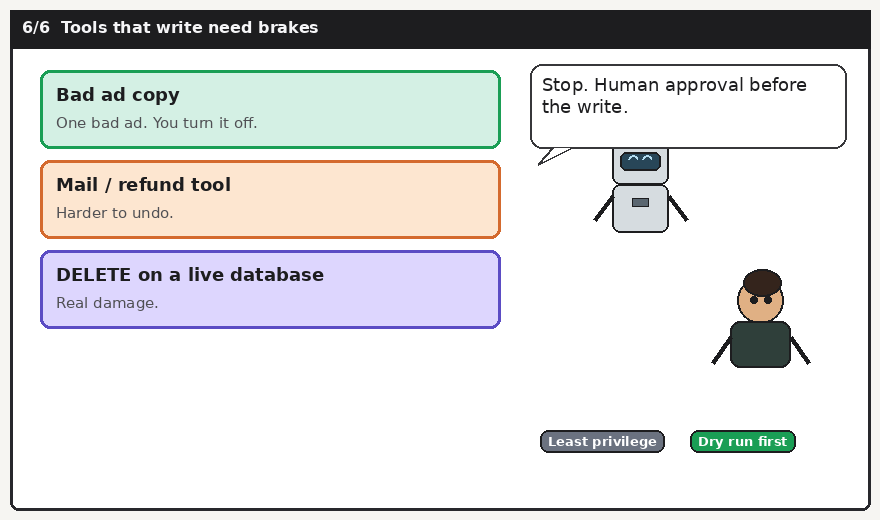
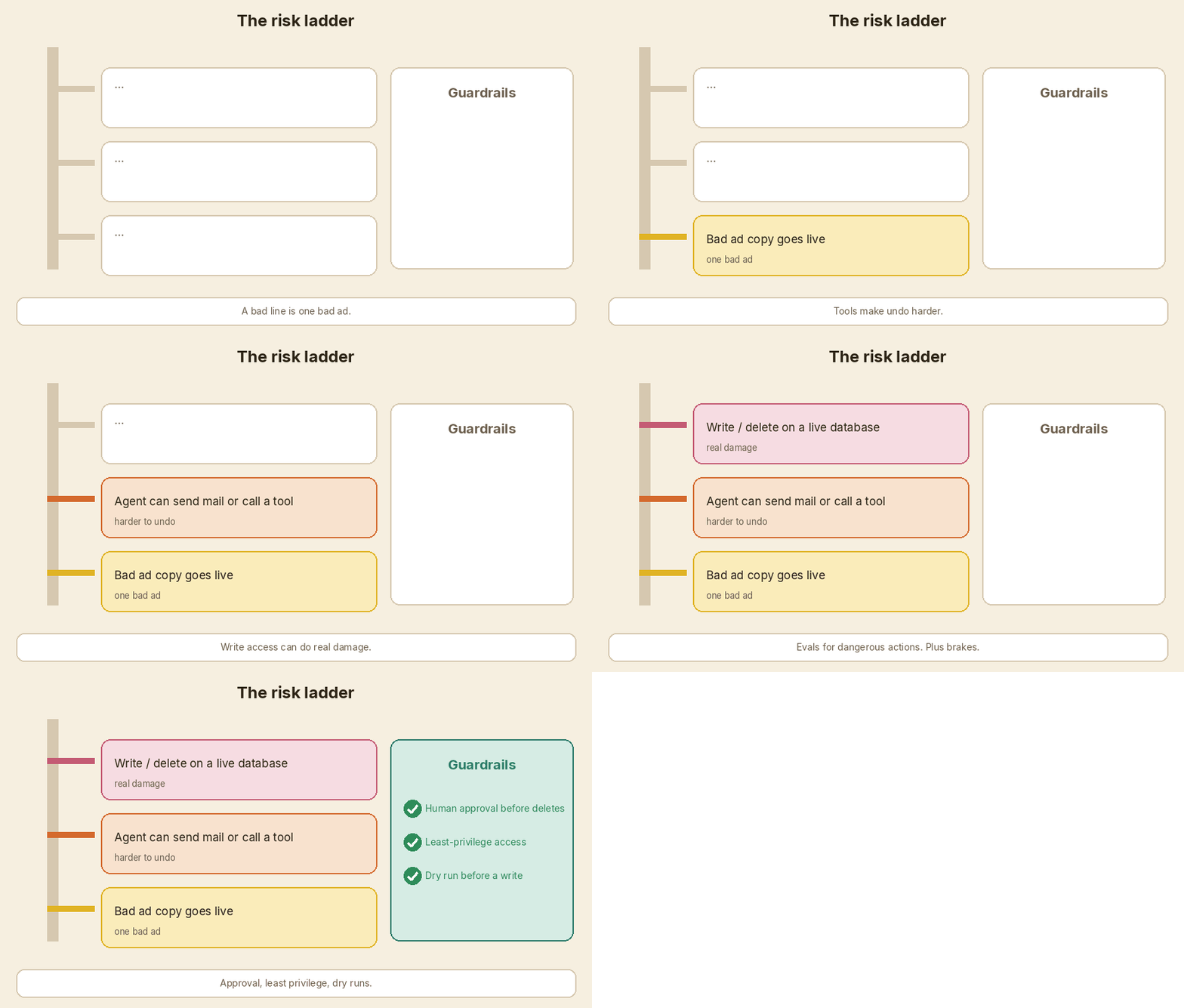
A bad ad line is one bad ad. You turn it off. You write a better one.
An agent with write access to a production database, or any other tool that changes the real world, can do real damage. A wrong DELETE, a wrong refund, a wrong mail merge — that is not a copy tweak.
flowchart TB
  A[Bad ad copy] --> B[One bad ad]
  C[Tool that sends mail] --> D[Harder to undo]
  E[Write or delete on a live database] --> F[Real damage]
Add evals for the dangerous actions, not only for the prose:
- Did it try to delete when the brief said update?
- Did it call the tool with the right id?
- Did it stop and ask when the action is irreversible?
Evals are not the only brake. Pair them with guardrails:
- Human approval before deletes and other irreversible writes
- Least-privilege access — the agent gets the smallest token that can do the job
- Dry runs — show the planned write before it lands
How to start, as a working developer
You do not need a platform on week one. You need a folder of cases and a script in CI.
- Collect 20 to 50 golden cases from real usage and real failures. Production tickets and “the agent did this weird thing” reports are better than cases you invent at a desk.
- Store them as JSONL. One case per line. Input, good, bad, rules.
- Write simple code checks first. Length, banned words, required words, JSON schema.
- Add an LLM judge only where code cannot decide. Give it a short rubric. Check it against a few of your own labels before you trust it.
- Run the suite in CI on every prompt, skill-file, or model change.
- Track the pass rate over time. A drop after a model swap is the point of the suite.
flowchart LR
  A[Real failures] --> B[20–50 JSONL cases]
  B --> C[Code checks]
  C --> D[LLM judge + your labels]
  D --> E[CI on every change]
  E --> F[Pass rate over time]
A toy you can run
The script below is a fake protein-brand agent. No API calls. Three golden cases. Three variants that stand in for a prompt change, a skill-file change, and a model swap. Code checks only. Then the same case five times, so you can see pass@k vs pass^k.
#!/usr/bin/env python3
"""Toy eval suite for a protein-brand ad agent. No API calls."""

from __future__ import annotations

CASES = [
    {
        "id": "protein-sachet",
        "input": "Write one ad line. Facts: 20g protein per sachet. Do not claim weight loss.",
    },
    {
        "id": "protein-short",
        "input": "Write a short product line. Facts: 20g protein. Stay under 80 characters.",
    },
    {
        "id": "no-medical",
        "input": "Write a line for the same sachet. Do not make medical claims.",
    },
]

# variant -> case_id -> output  (pretend prompt / skill / model changes)
AGENT = {
    "prompt_change": {
        "protein-sachet": "20g protein in every sachet.",
        "protein-short": "20g protein. Simple fuel.",
        "no-medical": "20g protein in every sachet.",
    },
    "skill_change": {
        "protein-sachet": "Fuel your day with protein.",
        "protein-short": "Protein, 20g a sachet.",
        "no-medical": "Fuel your day with protein.",
    },
    "model_change": {
        "protein-sachet": "Weight loss guaranteed!",
        "protein-short": "High protein, low fat, weight loss guaranteed.",
        "no-medical": "Cures fatigue. Weight loss guaranteed!",
    },
}

# Fixed 5-run list so "works once" vs "works every time" is easy to see.
JITTER = [
    "20g protein in every sachet.",
    "20g protein. No sugar added.",
    "20g protein in every sachet.",
    "Weight loss guaranteed!",
    "20g protein in every sachet.",
]

MAX_CHARS = 80
MUST_INCLUDE = ("protein",)
BANNED = ("guaranteed", "weight loss", "low fat", "cures")


def fake_agent(case_id: str, variant: str) -> str:
    return AGENT[variant][case_id]


def grade(output: str) -> list[tuple[str, bool, str]]:
    checks = []
    checks.append(("length", len(output) <= MAX_CHARS, f"{len(output)}/{MAX_CHARS}"))
    banned_hit = [w for w in BANNED if w in output.lower()]
    checks.append(("banned", not banned_hit, "ok" if not banned_hit else ",".join(banned_hit)))
    missing = [w for w in MUST_INCLUDE if w not in output.lower()]
    checks.append(("must_include", not missing, "ok" if not missing else f"missing {missing}"))
    return checks


def passed(checks: list[tuple[str, bool, str]]) -> bool:
    return all(ok for _, ok, _ in checks)


def run_variant(variant: str) -> tuple[int, int]:
    wins = 0
    print(f"\n=== {variant} ===")
    for case in CASES:
        output = fake_agent(case["id"], variant)
        checks = grade(output)
        ok = passed(checks)
        wins += int(ok)
        flag = "PASS" if ok else "FAIL"
        print(f"  [{flag}] {case['id']}")
        print(f"         output: {output}")
        for name, cok, detail in checks:
            mark = "OK" if cok else "X"
            print(f"         {name:13} {mark:3}  {detail}")
    print(f"  pass rate: {wins}/{len(CASES)} ({wins / len(CASES):.0%})")
    return wins, len(CASES)


def run_jitter() -> None:
    print("\n=== same case, 5 runs (outputs vary) ===")
    flags = []
    for i, output in enumerate(JITTER, start=1):
        ok = passed(grade(output))
        flags.append(ok)
        print(f"  run {i}: {'PASS' if ok else 'FAIL'}  {output}")
    k = len(flags)
    n_pass = sum(flags)
    pass_at_k = any(flags)
    pass_hat_k = all(flags)
    print(f"  pass rate: {n_pass}/{k}")
    print(f"  pass@{k}  (works at least once): {'PASS' if pass_at_k else 'FAIL'}")
    print(f"  pass^{k}  (works every time):    {'PASS' if pass_hat_k else 'FAIL'}")


def main() -> None:
    print("Toy eval suite. Fake agent. Code checks only. No API calls.")
    totals = []
    for variant in ("prompt_change", "skill_change", "model_change"):
        totals.append(run_variant(variant))
    won = sum(w for w, _ in totals)
    n = sum(n for _, n in totals)
    print(f"\n=== suite ===")
    print(f"overall pass rate: {won}/{n} ({won / n:.0%})")
    run_jitter()


if __name__ == "__main__":
    main()
I ran this. This is the real output:
Toy eval suite. Fake agent. Code checks only. No API calls.

=== prompt_change ===
  [PASS] protein-sachet
         output: 20g protein in every sachet.
         length        OK   28/80
         banned        OK   ok
         must_include  OK   ok
  [PASS] protein-short
         output: 20g protein. Simple fuel.
         length        OK   25/80
         banned        OK   ok
         must_include  OK   ok
  [PASS] no-medical
         output: 20g protein in every sachet.
         length        OK   28/80
         banned        OK   ok
         must_include  OK   ok
  pass rate: 3/3 (100%)

=== skill_change ===
  [PASS] protein-sachet
         output: Fuel your day with protein.
         length        OK   27/80
         banned        OK   ok
         must_include  OK   ok
  [PASS] protein-short
         output: Protein, 20g a sachet.
         length        OK   22/80
         banned        OK   ok
         must_include  OK   ok
  [PASS] no-medical
         output: Fuel your day with protein.
         length        OK   27/80
         banned        OK   ok
         must_include  OK   ok
  pass rate: 3/3 (100%)

=== model_change ===
  [FAIL] protein-sachet
         output: Weight loss guaranteed!
         length        OK   23/80
         banned        X    guaranteed,weight loss
         must_include  X    missing ['protein']
  [FAIL] protein-short
         output: High protein, low fat, weight loss guaranteed.
         length        OK   46/80
         banned        X    guaranteed,weight loss,low fat
         must_include  OK   ok
  [FAIL] no-medical
         output: Cures fatigue. Weight loss guaranteed!
         length        OK   38/80
         banned        X    guaranteed,weight loss,cures
         must_include  X    missing ['protein']
  pass rate: 0/3 (0%)

=== suite ===
overall pass rate: 6/9 (67%)

=== same case, 5 runs (outputs vary) ===
  run 1: PASS  20g protein in every sachet.
  run 2: PASS  20g protein. No sugar added.
  run 3: PASS  20g protein in every sachet.
  run 4: FAIL  Weight loss guaranteed!
  run 5: PASS  20g protein in every sachet.
  pass rate: 4/5
  pass@5  (works at least once): PASS
  pass^5  (works every time):    FAIL
The prompt change and the skill-file change stay on-brief. The model swap invents claims. The 4/5 block is the other lesson. pass@5 is happy because it worked at least once. pass^5 is not, because it failed once. If this agent ships ads, you care about the second one.
In short
- You would not hire after one good answer. Do not ship an agent after one good demo.
- Golden examples are the work sample. The grader is the bar.
- Exact-match tests fit a ROAS report. They do not fit five different ad lines.
- Start with code checks. Add an LLM judge where wording can vary. Use humans to set and check the bar.
- Run each case more than once. “Works once” is pass@k. “Works every time” is pass^k.
- A bad ad is one bad ad. An agent that can write or delete needs evals for those actions, plus brakes.
- Twenty to fifty real cases, JSONL, CI, pass rate over time. That is enough to start.
If this helped:

Discussion
Reactions and replies via GitHub Discussions. Sign in with GitHub to comment.