Jev: Stamp the Answer, Don't Write It
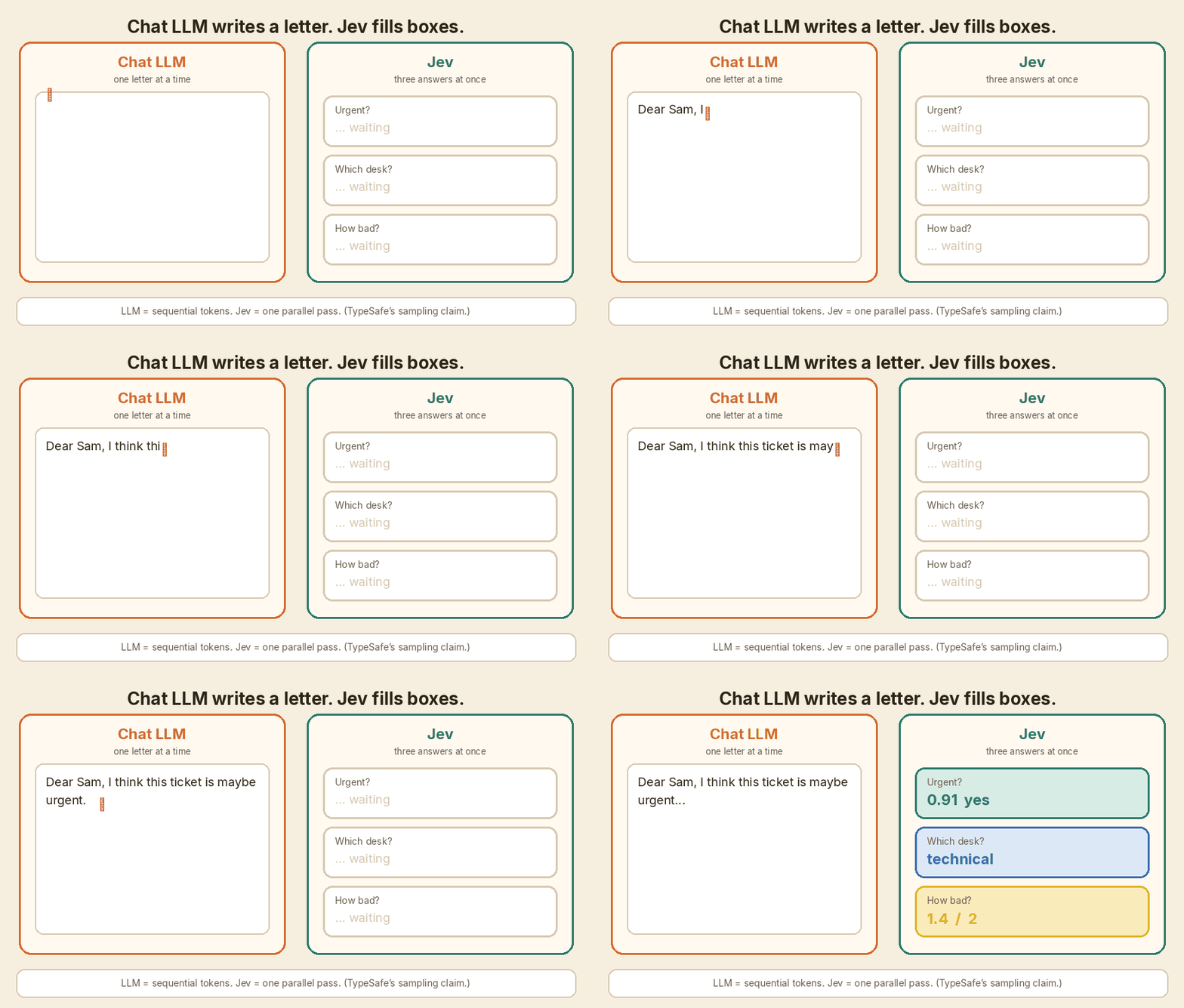
Chat models write text.
Jev fills labeled fields.
It is not a chat LLM. You send facts and a list of questions. It sends back typed guesses your code can read — a yes/no number, one winning label, a score on a scale.
A chat model writes a paragraph: “Hmm, maybe this is urgent…” Jev returns urgent? which team? how bad? Then your code routes the ticket.
What Jev is
TypeSafe AI made it (San Francisco, 2024). Jev is their first public System One model. Early access: 15 September 2026.
Founder Diogo Almeida has said in TypeSafe’s launch post that he helped build the RLHF / InstructGPT-era methods that made models follow instructions and talk. That is his claim. Do not turn it into “he invented ChatGPT.”
flowchart LR
  A[Your app] -->|state + questions| B[POST /v1/systemone]
  B --> C[Jev]
  C -->|typed answers + probs| D[Your code]
  D --> E[if / route / score]
  D --> F[LLM only if you need prose]
Keep the chat model for prose. Keep Jev for smart if-statements.
Two names
System One is the kind of model. TypeSafe borrowed it from Daniel Kahneman: System 1 is fast (catch the ball); System 2 is slow (write the essay). They want snap judgments a person could make in a second if they had the facts.
Jev is named after William Stanley Jevons. The Jevons paradox: cheaper coal meant more engines, not fewer. TypeSafe’s bet: cheap guesses go into more places — routing, scoring, guardrails.
System One is the kind. Jev is this model.
How you talk to it
One endpoint: POST https://api.typesafe.ai/v1/systemone
Three fields:
state— the facts. Text, JSON, or a list of text. Official docs: text only. No pictures, no audio, no video (yet).model— which model.jev-latestis the alias. Official models page (as of this draft): that alias points atjev-1.13.0. Pin the versioned id in production.questions— a map of judgments. You name the keys. Answers come back under the same keys. Write the real question ininstructions.
Jev looks at the state once. It answers every question in one parallel pass.
You list the legal values first. TypeSafe’s claim: Jev cannot emit a value outside that list. Easy to falsify if it ever happens.
A field can still be the wrong value. That is not a type error. That is a bad guess.
Three primitives
There is no fourth type. Official TypeSafe docs: Noul, Choice, Score. TypeSafe has not said what Noul stands for. Treat it as a made-up name.
| Type | What it does | Returns | Official limits |
|---|---|---|---|
| Noul | Yes/no | Probability 0–1. No extra confidence field. The number is the belief. | Yes/no only. 0.5 means “I cannot tell,” not “medium.” |
| Choice | Pick one labeled option | Winner + all probabilities + confidence | Up to 255 options |
| Score | Place on an ordered scale | Score (can sit between rungs) + probs + confidence | 2–10 levels |
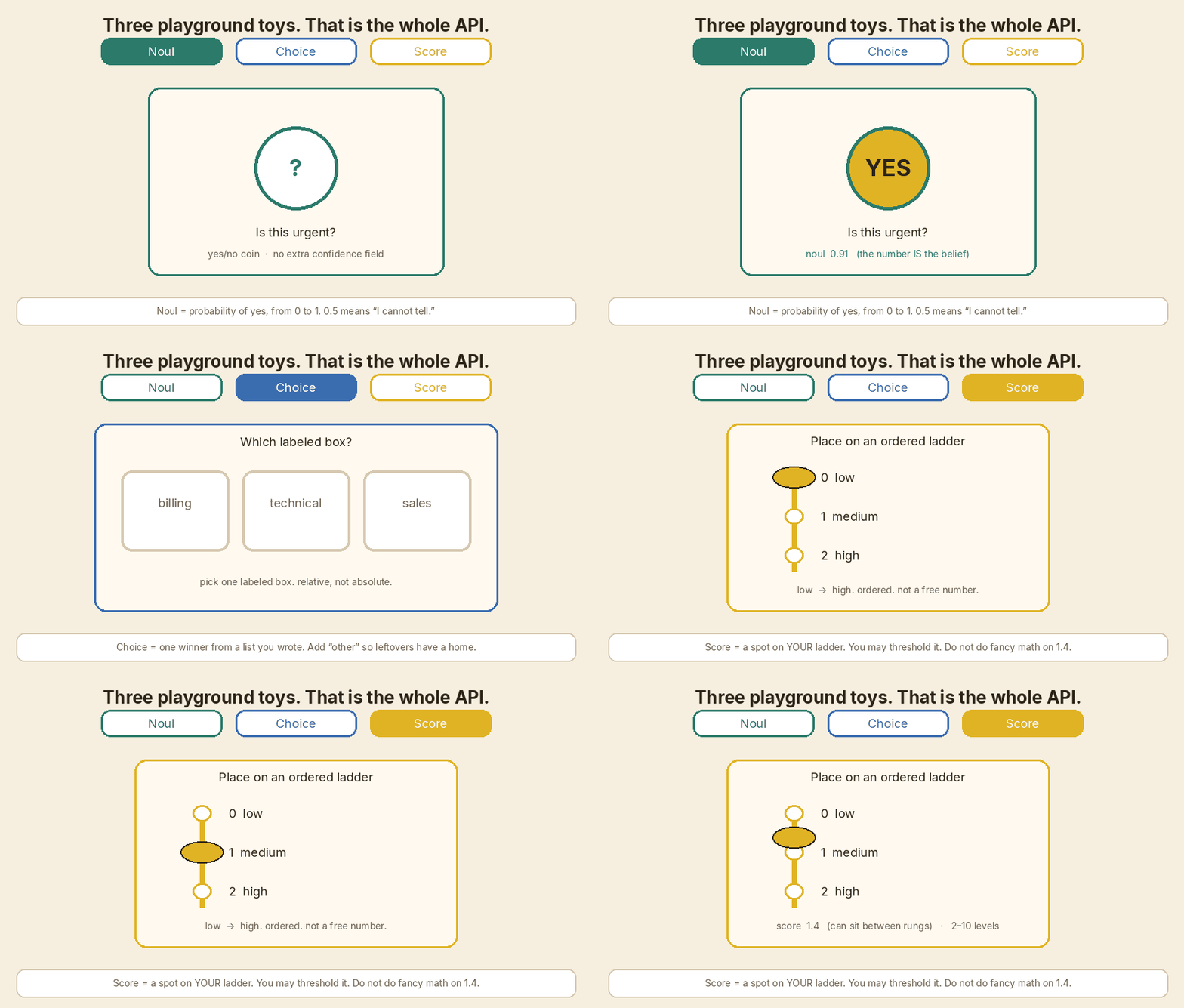
Noul: is this true, by itself? Choice: who wins this race (add other if the list might miss). Score: where on this scale? Three rungs live on 0, 1, 2; 1.6 sits between 1 and 2. Threshold if you want. Do not treat 1.6 as “80% angry.”
They do not swap. TypeSafe published this trap. Same refund question: a Noul said 0.22; a yes/no Choice said no at 0.99. Opposite vibes. Two Nouls that look like opposites do not have to add to 1. Never copy a Noul cut onto a Choice.
One ticket, three questions
Made-up ticket. No real people. The numbers are a teaching story, not a live Jev call. The shape follows TypeSafe’s published examples.
Shared state: “I was charged twice. Please refund the extra charge today.”
| Name | Type | What you asked | Teaching answer | What it is not |
|---|---|---|---|---|
| team | Choice | Which team? | billing |
Not a reply to the customer |
| urgency | Score | How soon? 0 routine, 1 today, 2 now | 1.05 — between “today” and “now” | Not hours |
| refund_requested | Noul | Did they ask for a refund? | 0.95 | Not approved — they asked |
{
  "state": {
    "ticket": "I was charged twice. Please refund the extra charge today."
  },
  "model": "jev-1.13.0",
  "questions": {
    "team": {
      "type": "choice",
      "instructions": "Which team should handle this?",
      "criteria": {
        "billing": "Money, refunds, charges",
        "technical": "Bugs, broken buttons, outages",
        "sales": "Pricing, upgrades, new accounts",
        "other": "None of those"
      }
    },
    "urgency": {
      "type": "score",
      "instructions": "How soon does this need a person?",
      "criteria": ["Routine. It can wait.", "Today.", "Now."]
    },
    "refund_requested": {
      "type": "noul",
      "instructions": "Did the customer ask for a refund?"
    }
  }
}
Your code: billing queue; you pick the “today” cut; they almost surely asked — a person still owns the money.
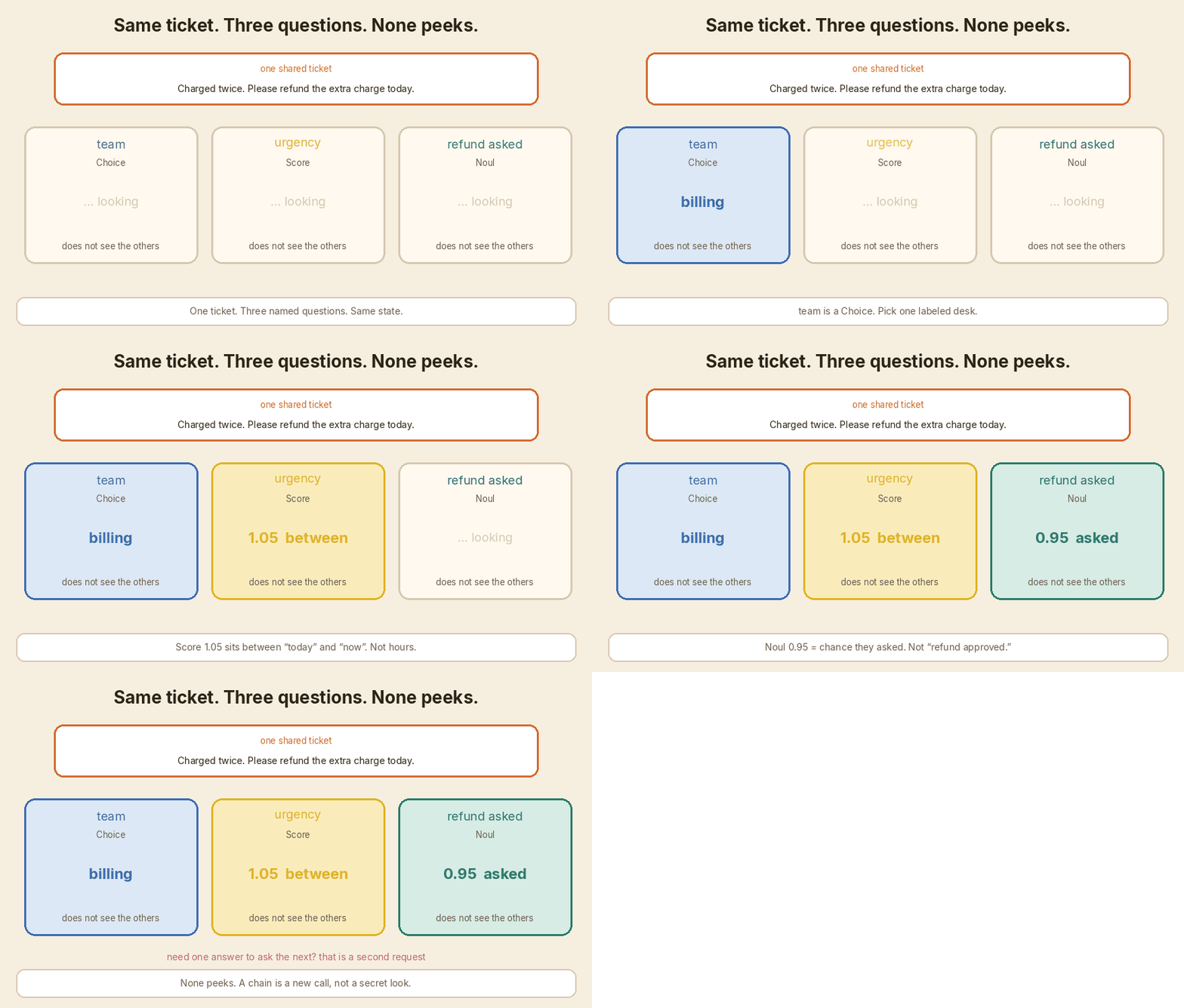
None peek. All three read the same ticket. None sees another’s answer. Official docs: ask every shared-state question in one request (output is free; they run in parallel). Need a chain — “now that it is billing, is this a chargeback?” — send a second call.
The labels travel with the request
A usual fine-tuned classifier learns its labels at training time. Those classes stay frozen. Want “subscriptions”? Collect more labels and train again.
Jev reads the labels from the request. TypeSafe does not offer customer fine-tuning. Official models page: same weights for every account. You still need known stamps to check a new label. You do not need to train to try it.
Fair caveat: some NLI zero-shot tools can also take new labels at call time. We are comparing Jev with the usual frozen classifier, not every encoder trick. This is behavior, not Jev’s insides. TypeSafe has not published those. Do not say Jev is BERT.
Same shape from the LLM you already have
Production agents often need a fixed set of answers, not a sentence. Which team? Jailbreak or not? How bad? Those jobs sit in routing and guardrails, before or beside the chat model that writes.
A common LLM shortcut: one forward pass, then read the scores on the allowed answers. You look at the numbers on each option. You do not write a paragraph.
Two traps:
- Order-flip — shuffle the options and the winner can change.
- Uncalibrated probabilities — the numbers look sure, but they lean. “90%” might not mean “right 90 times out of 100.”
Fixes, conceptually:
- No labels? Training-free debiasing. Example: score every cyclic shift of the list so order is less of a cheat, then fix the model’s favorite-label habit without looking at answers (a label-free prior).
- Have labels? Post-hoc calibration, like temperature scaling — stretch or squash the numbers so they match how often you are really right.
Useful names:
| Metric | Meaning |
|---|---|
| Order-flip rate | How often the winner changes when you shuffle the list |
| Calibration error | How far the “I’m 90%” pile is from being right 90% of the time |
| Auto-decide at a chosen risk | If you only act when you stay under a mistake line you picked, how many tickets still get an answer? |
AnyJev is one public open kit for this wrap. GitHub MorrisZJ/AnyJev. pip install anyjev. It wraps the LLM you already run so answers come back typed, with probabilities, training-free by default.
It is not affiliated with TypeSafe. It is not “Jev went open source.” Do not claim it matches Jev’s speed or quality. AnyJev’s own benches are theirs, not a shared bake-off.
You would still want dedicated Jev or Laya when you want a hosted API, a published open kit, or TypeSafe’s published latency/price story — and you do not want to run and babysit your own wrap.
Beliefs and cuts
TypeSafe’s training name is RLCD — Reinforcement Learning for Calibrated Decisions.
- RLHF (chat-era) rewards “text people like.”
- RLCD (their name) rewards “probabilities that match how often you are actually right.”
Calibrated means: when it says about 90% on many guesses, it should be right about 90% of the time. One batch can still be wrong. RLCD is a vendor target, not a certificate for your tickets.
Confidence (Choice and Score) is how bunched the probability mass is. It is not a second test. Pick cuts on tickets where you already know the stamp. A wrong refund and a wrong queue cost different amounts.
TypeSafe’s published claims (theirs, not ours):
| Claim | What they published | How to hold it |
|---|---|---|
| Speed | ~70–500 ms end-to-end | Company number. They note many evals were run from West Coast laptops near the service. |
| Price | $0.042 per million input tokens; output free | Official models page. Output “too cheap to meter.” Your bill is mostly how fat state is and how often you send it. |
| Type errors | Cannot emit a value outside the schema you sent | By construction, they say. Easy to falsify if it ever happens. |
| Context | 64k tokens per request; 32k for state plus the longest question |
Official models page. |
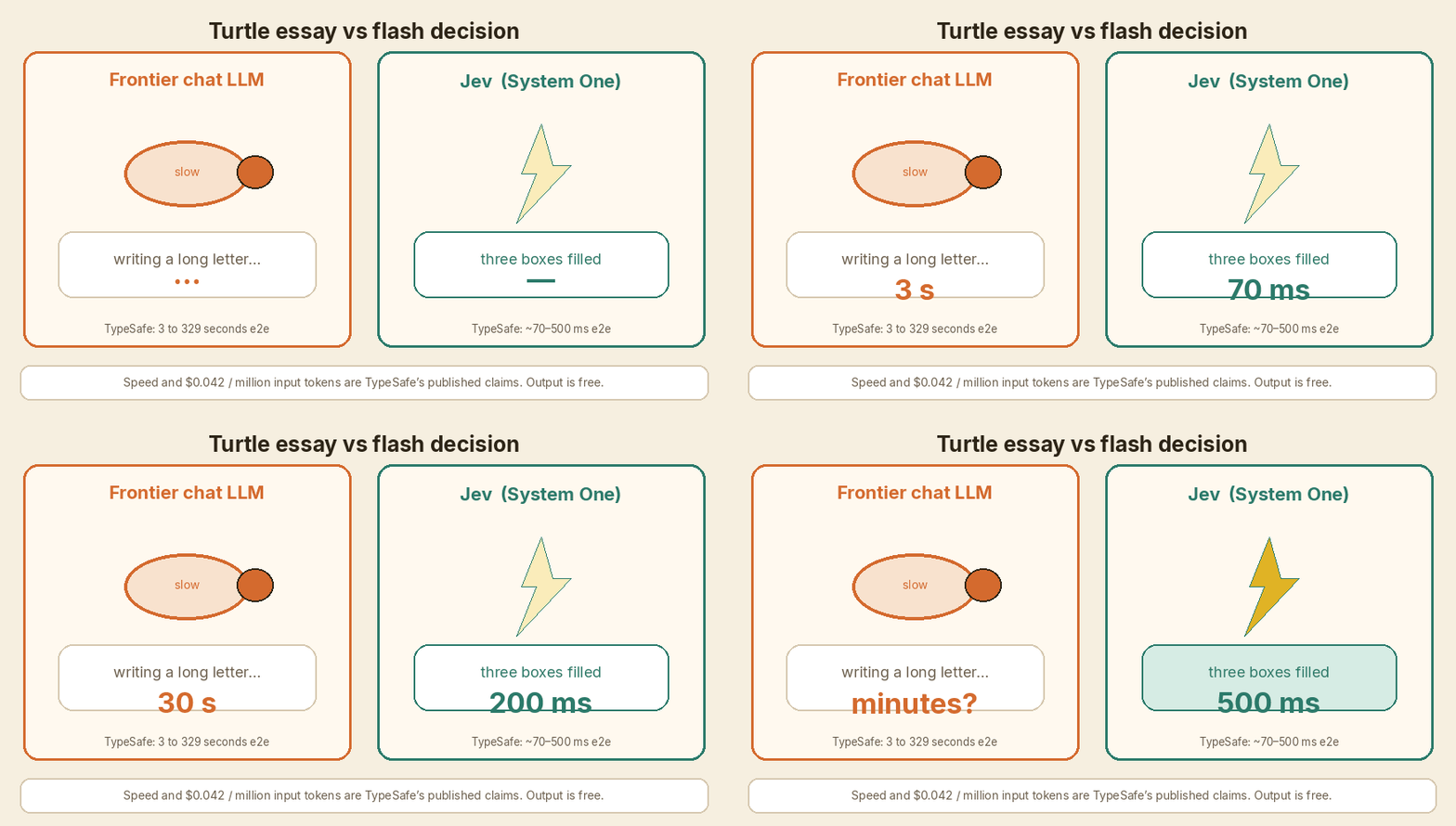
They also publish big “faster / cheaper” multipliers from their workflow evals and say those sit at the high end. Official: they say they do not train on customer requests. They have not published architecture or weights. Do not invent layers.
Two hosted options and a wrap
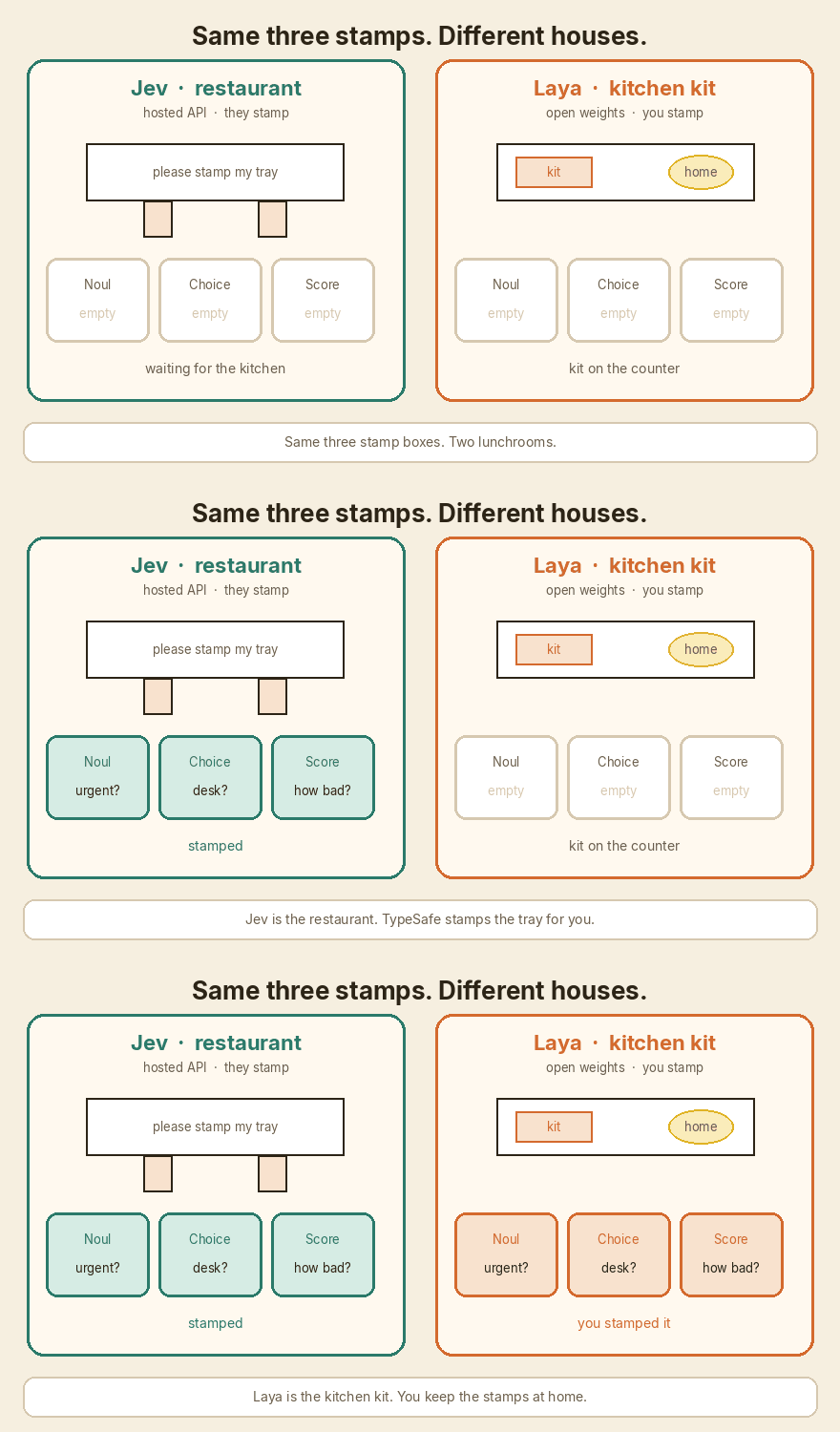
- Jev (TypeSafe) = dedicated System One decision model. A hosted API. You
POST. They return typed fields. - Laya (Convai Innovations) = open kit with the same three primitives. Apache 2.0.
pip install laya. You run it. Convai publishes more of its recipe (encoder + typed head). That is Convai’s, not Jev’s. - AnyJev-style wrap = the LLM you already run, answering like a decision model (typed + probs). Complementary. Not “Jev is open source.”
| Jev (TypeSafe) | Laya (Convai) | AnyJev-style wrap | |
|---|---|---|---|
| What it is | Hosted decision model | Open-weight kit; you run it | Layer on the LLM you already have |
| Types | Noul / Choice / Score | Same three | Same shape (typed + probs) |
| Training | Hosted; you change the request | You may fine-tune a checkpoint | Training-free by default; labels only if you calibrate |
| Best first try | Managed API + published token price | Local / air-gap / own weights | You already run an LLM and want fields, not a new service |
Convai publishes a “Laya vs Jev” scoreboard. That is Convai’s comparison, not an independent shared bake-off. We will not invent a winner. Test your tickets.
Jev is the hosted API. Laya is the kit. The wrap uses the model you already run.
When to use it
Start with the answer your product needs.
| Start with code when… | Try a decision model when… | Use a generative LLM when… |
|---|---|---|
| You can calculate it exactly | You can list the answers: a category, a yes/no, a rung | You need a reply, an explanation, or a plan |
The rule is an if you can write |
You want to pick, rate, or check something in text | You need deeper reasoning |
| You already found the candidate values | You pick from values your code already found | There is no fixed list |
It cannot pick an email your code missed. It is not a search box.
Use it for snaps your code can act on: if-statements, routing, scoring, map-reduce, ~100 ms UX (TypeSafe’s story), guardrails. Skip it for essays, open chat, or answers that are not a coin, a box, or a short scale. No pictures / audio / video as input.
Cascade — cheap snap first, letter last:
flowchart TB
  T[Ticket / log / agent trace] --> S[Decision model: Noul + Choice + Score]
  S --> C{Code thresholds}
  C -->|high confidence + easy shape| A[Act: route, block, file]
  C -->|medium / messy| H[Human review]
  C -->|need a paragraph or patch| L[Frontier LLM]
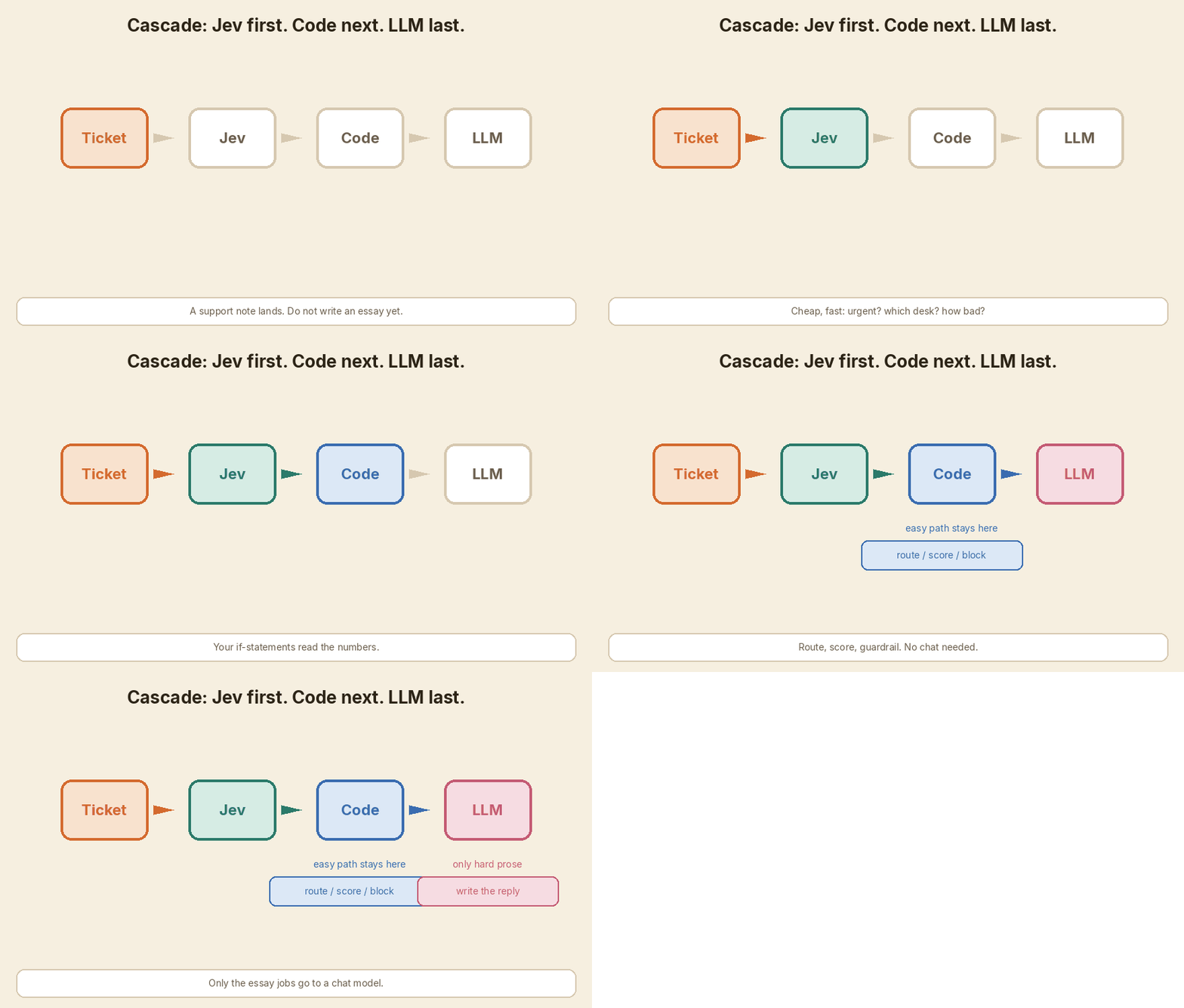
Fill the fields. Code moves the ticket. The LLM writes the note — if a note is even needed.
Honest caveats
- Early access. Pin
jev-1.13.0(or the version you tuned).jev-latestcan move. - Company evals are theirs. Speed, price, and the big “faster / cheaper” multipliers are TypeSafe’s numbers. They say the multipliers are likely upper end.
- Wrong ≠ type error. Schema safety does not make a high-stakes refund automatic. Set cuts. Escalate.
- Choice and Noul are not twins. Relative vs absolute. Do not swap them and keep the same cut.
- RLCD is a target, not a certificate. Confidence is how bunched the probability mass is — not a second test.
- New labels still need a quiz. Labels travel in the request. You still need known stamps to see if guesses are good enough.
- Architecture is unpublished. Describe what Jev does. Do not claim it is BERT. Laya’s encoder is Convai’s.
- Wraps and scoreboards are not Jev. AnyJev is not affiliated with TypeSafe and does not claim Jev’s speed or quality. Convai’s Jev table is not a shared bake-off.
Official references:
- Introducing System One Models & Jev (TypeSafe launch, 15 Sep 2026)
- System One
- Primitives
- HTTP API
- Models, price, limits
- Noul / Choice / Score tutorials
- First call
Laya / Convai (vendor pages; claims are theirs):
AnyJev (independent; not affiliated with TypeSafe):
In short
Chat writes text. Decision models return typed fields. Send state plus named questions. Get numbers your if can read. One ticket can feed many independent questions — none peeks. Start with code when you can calculate. Use Jev, Laya, or an LLM wrap to pick, rate, or check. Keep the chat model for the letter.
If this helped:

Discussion
Reactions and replies via GitHub Discussions. Sign in with GitHub to comment.