The Intelliwise — lunch-box note
Diffusion — longer guide
Start from TV static. Undo noise, a little at a time, until a picture (often in a small latent grid) appears.
This is the picture makers (now) box on the lunch-box map. Two papers share the tray: DDPM (Ho, Jain, Abbeel) for the cleanup loop, and Latent Diffusion (Rombach et al.) for the Stable Diffusion lineage — denoise in a VAE-sized grid, not on every pixel.
What problem it solves
Messy chalk → wipe carefully → drawing.
You want high-quality image samples without a GAN’s two-player mood. Diffusion models learn to reverse a noise process. Add Gaussian noise to real photos until they are static; train a net to predict the noise (or the clean image) at each step; at generate-time, start from static and undo step by step. Latent diffusion does that undo in a compressed grid so high-res images fit a single GPU story.
| DDPM (2020) | Latent Diffusion (2021) |
|---|---|
| Denoise in pixel space | Denoise in an autoencoder latent |
| Landmark maths / quality | The cheap “type words, get a picture” lineage |
| CIFAR / LSUN-style tests in the paper | LAION-scale text-to-image in the LDM paper |
How the idea works
Forward (destroy): for timestep t = 1 … T, mix the photo with a little more noise. At large T you have TV static. This process is fixed; you do not learn it.
Reverse (clean): a neural net (U-Net in both landmark papers) sees a noisy canvas plus t, and guesses the noise that was added. Subtract a bit. Repeat.
Latent twist:
- Train (or reuse) an autoencoder that packs a photo into a small spatial code — this is the VAE lunch box.
- Run DDPM-style denoising on that code.
- Decode once at the end to pixels.
- Text: encode the prompt; let the U-Net cross-attend to those tokens (“a red bicycle in the rain”).
flowchart LR
  N[noise] --> U[undo one step]
  U --> U
  U --> P[clean latent]
  P --> D[VAE decode]
  D --> I[picture]
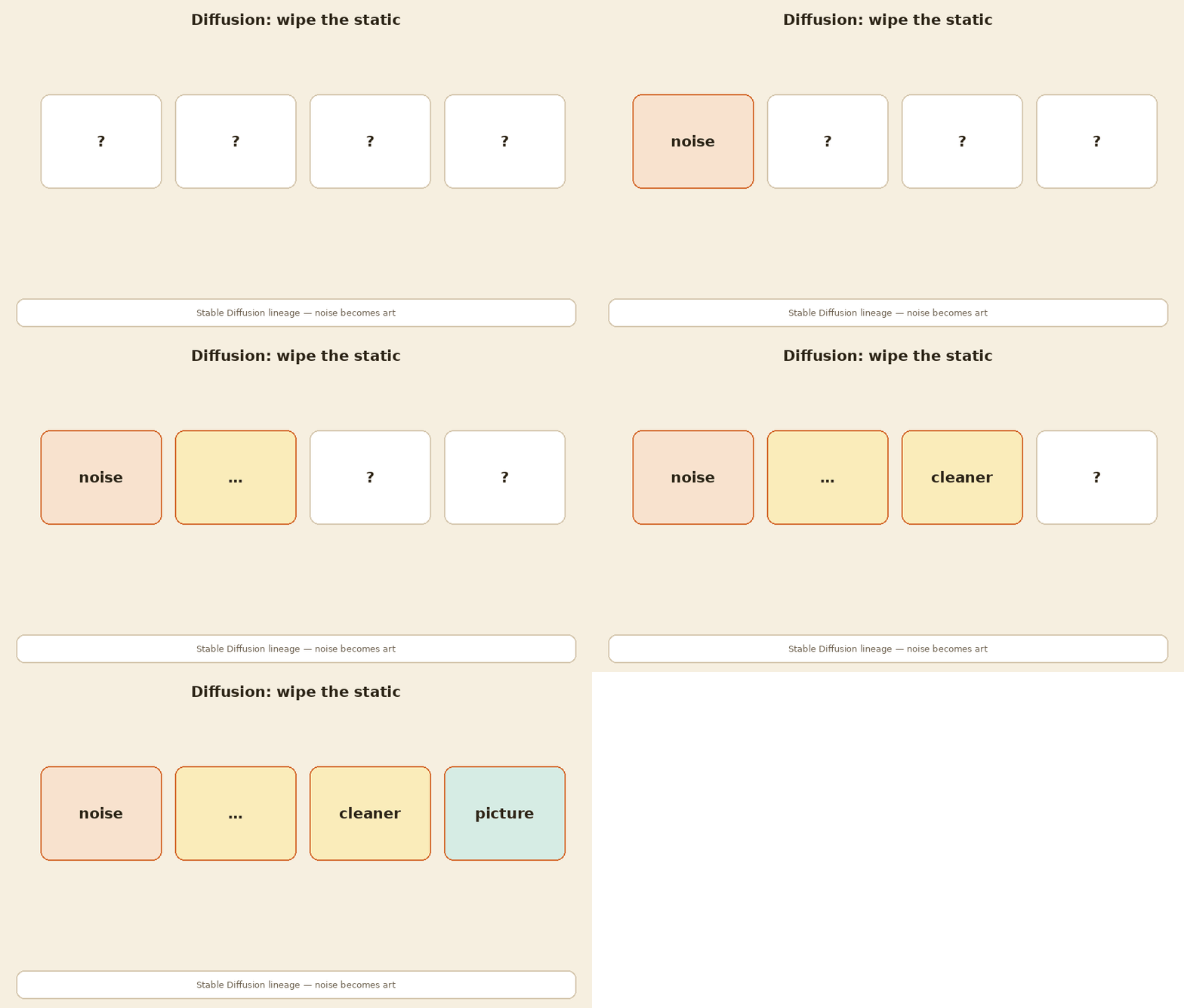
Simple picture: a dusty chalkboard. You do not draw the cat in one stroke. You wipe a little dust, then a little more. Start from a blank dusty board (pure noise) and wipe toward the prompt.
Why so many steps? Each undo is easy. A hundred easy undos beat one impossible “paint a cat from scratch” shot. Distillation later reduces steps for products. The landmark papers are the many-step story.
Why it mattered / what it unlocked
- This is how most prompt-to-image tools work now. The brand on the box changes. The undo loop + latent zipper keeps showing up.
- Latent diffusion made the compute honest. Pixel-space DDPM at high res is a lab sport. A 8× smaller latent is a product.
- Cross-attention as a steering wheel. Text (and later layout / pose) plug in without inventing a new engine.
- The same cleanup idea jumped. Audio and video diffusion are this box with extra axes, not a new lunch tray.
- History vs now. GANs were the sharp-sample kings. Diffusion took the product crown. Keep both on the map.
Honest data notes (same as the map). The LDM paper talks about LAION-400M for large text-to-image training and uses MS-COCO as an evaluation set. Those are the links we keep. Do not invent a “Stable Diffusion official zip” that is not in the paper.
What to remember
- Destroy with noise; learn to undo one step; repeat.
- DDPM = pixel (or small-image) landmark. LDM = latent + text lineage.
- The zipper is a VAE-like autoencoder. The artist is the denoiser.
- Prompts steer via cross-attention, not via a second GAN fight.
- Step count is quality vs speed. Products distill; papers show the long walk.
When to read the real papers
Open DDPM when you want:
- the discrete Markov chain, the loss that reduces to “predict the noise,” and the CIFAR/LSUN figures
Open Latent Diffusion when you want:
- the autoencoder + U-Net + cross-attention recipe
- how they condition on text
- LAION-400M / MS-COCO experimental notes
Skip both PDFs if you only needed “static → wipe → picture, often in a small code.”
Links
- DDPM — Ho et al., arXiv 2006.11239
- Latent Diffusion / Stable Diffusion lineage — Rombach et al., arXiv 2112.10752
- LAION-400M (text-to-image training in the LDM paper)
- LAION-400M project page
- MS-COCO (eval set in that paper)
Back on the tray: lunch-box map · zipper VAE · history GANs