14 AI Papers: A Lunch-Box Reading Map
Fourteen research papers every AI engineer keeps hearing about.
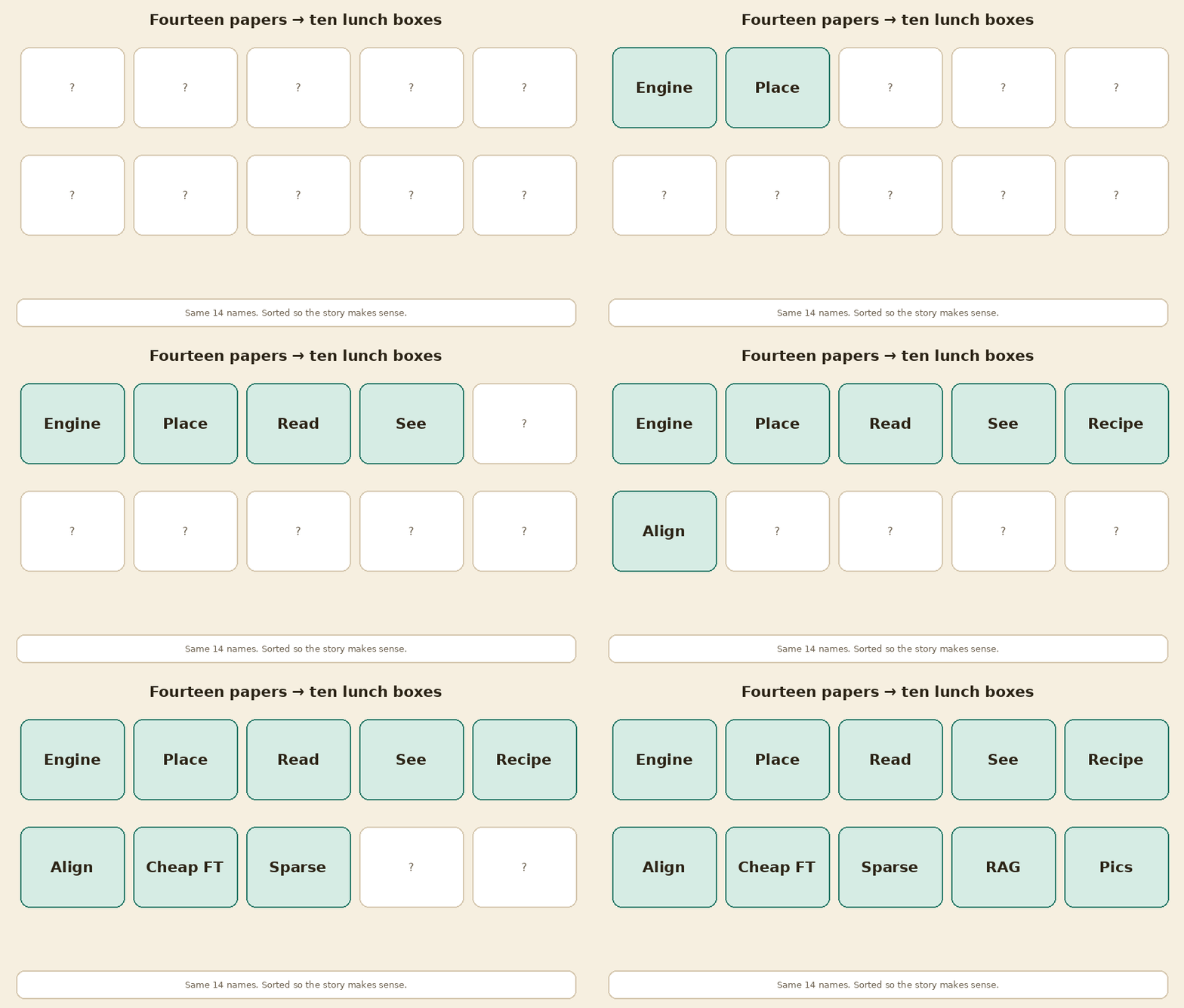
The usual list is a checklist. This post is a lunch-box map.
Same 14 names. Grouped so you can see why each box exists, and which box to open first.
I did not invent these papers. I only sorted the tray.
Each paper has three layers:
- This map — why the box exists, a short Quick easy read, and the diagrams.
- A longer guide — still brief, enough that you do not need to grind the PDF. Linked from the table and from each paper. These guides live under this post. They are not listed on the Writing index or in the RSS feed.
- The real paper — official abstract, PDF, conference page, and a Dataset link only when a public corpus is honestly tied to that paper.
Skim the map. Open the longer guide when you want more detail. Open the paper when you want the proof.
flowchart TB
  A[Engine: Transformers] --> B[Place words: RoPE]
  A --> C[Read both ways: BERT]
  A --> D[See pictures: ViT]
  A --> E[Open recipe: LLaMA]
  E --> F[Follow instructions: InstructGPT + RLHF]
  E --> G[Cheap fine-tune: PEFT + LoRA]
  E --> H[Sparse giants: MoE]
  E --> I[Look stuff up: RAG]
  J[Old image makers: GAN + VAE] --> K[New image makers: Diffusion]
The habit to keep:
Do not memorise 14 titles. Learn the lunch boxes.
The 14 names (same order as the boxes below)
Names jump to the box. Paper goes to the official abstract. Longer guide is the unlisted sub-page.
| # | Short name | In one line | Longer guide |
|---|---|---|---|
| 1 | Attention Is All You Need · paper | The engine that looks at every word at once | guide |
| 2 | RoPE · paper | A clean way to tell the model where a word sits | guide |
| 3 | BERT · paper | Read left and right to understand a sentence | guide |
| 4 | ViT · paper | Cut a photo into patches; use a transformer | guide |
| 5 | LLaMA · paper | Meta’s open-ish large language model recipe | guide |
| 6 | InstructGPT · paper | Train the model to follow instructions | guide |
| 7 | RLHF · paper | Humans score answers; the model learns preference | guide |
| 8 | LoRA · paper | Train a small add-on instead of rewriting a big model | guide |
| 9 | PEFT · docs | The family name for cheap fine-tuning | guide |
| 10 | MoE · paper | Many small experts; only a few wake up | guide |
| 11 | RAG · paper | Look up notes before you answer | guide |
| 12 | GANs · paper | Generator vs discriminator, fighting until fakes look real | guide |
| 13 | VAE · paper | Squeeze a picture into a small code, then rebuild | guide |
| 14 | Diffusion · paper | Start from noise; slowly clean it into a picture | guide |
Now the boxes.
Box 1 — The engine room
Attention Is All You Need (Transformers)
Longer guide → more detail without grinding the PDF
Before this, models often read words one after another, like a single-file line.
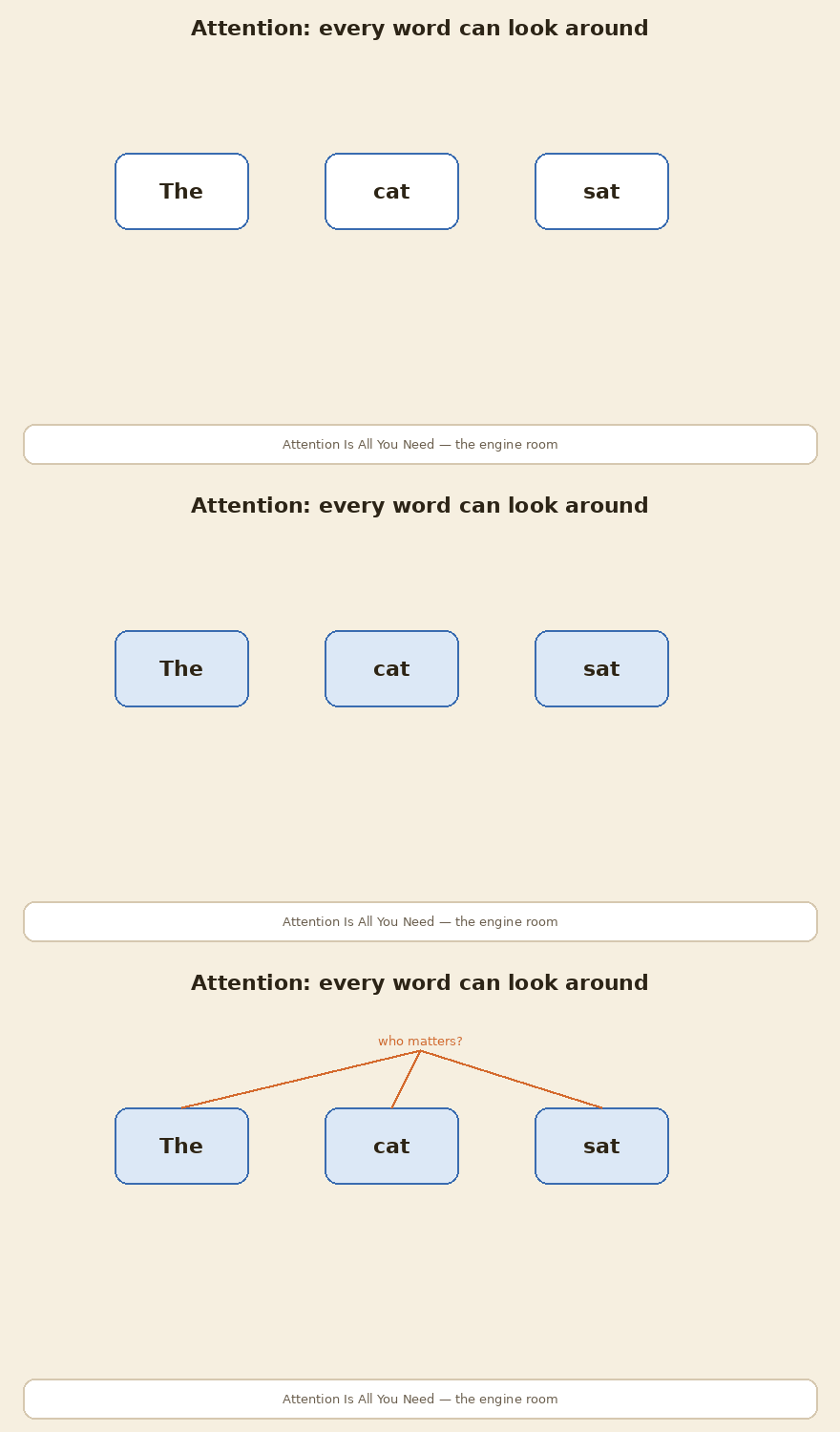
Attention lets every word look at every other word and ask: “Who matters for me right now?”
That paper (2017) is why ChatGPT-style models exist.
flowchart LR
  W1[word] --> A[Attention]
  W2[word] --> A
  W3[word] --> A
  A --> O[rich meaning]
Read when: you want the root of modern LLMs.
Quick easy read
What it is
- A new engine for reading sequences. No slow “one word, then the next” loop as the main trick.
- Every token can look at every other token in one go (self-attention).
- Stack those looks with a little feed-forward maths: that stack is a Transformer.
- The 2017 paper tested it on translation. The same engine later showed up in chat, code, and pictures.
Why people care
- GPUs like work they can do in parallel. Attention is much more parallel than old recurrent nets.
- One engine, many jobs: text, code, images (see ViT), even tools that call other tools.
- If you only open one paper on this tray, open this one.
Simple picture
Think of a meeting where everyone can look at everyone else at the same time, instead of passing a note down a single line. The word “bank” looks at “river” and “money”, then decides which neighbours matter.
Links: Paper (arXiv) · NeurIPS 2017 · Dataset: WMT 2014 translation task (the paper’s English–German / English–French news tests)
Box 2 — Where am I in the line?
RoPE (Rotary Position Embedding)
Longer guide → more detail without grinding the PDF
Transformers need to know order. “Dog bites man” is not “Man bites dog.”
RoPE rotates number vectors so position is baked into attention. Many open models, including LLaMA-style stacks, use ideas like this.
In one line: the model needs a seat number, not just the word itself.
Quick easy read
What it is
- Attention is good at “who talks to whom.” It does not know where unless you tell it.
- RoPE (from the RoFormer paper) turns each token’s numbers a little, like rotating a clock hand, based on position.
- Nearby positions rotate a little. Far positions rotate a lot. Relative distance comes out of the rotation.
Why people care
- Order is not optional in language, logs, or code.
- A lot of later open LLMs (LLaMA-family and cousins) use rotary-style position.
- It stretches to longer sequences more kindly than some older “add a position vector” tricks.
Simple picture
Two people on a spinning ride. How much one has turned relative to the other is how far apart they sit. You do not need a separate name tag that says “seat 7.”
Links: Paper — RoFormer / Su et al. (arXiv)
Box 3 — Reading both ways
BERT
Longer guide → more detail without grinding the PDF
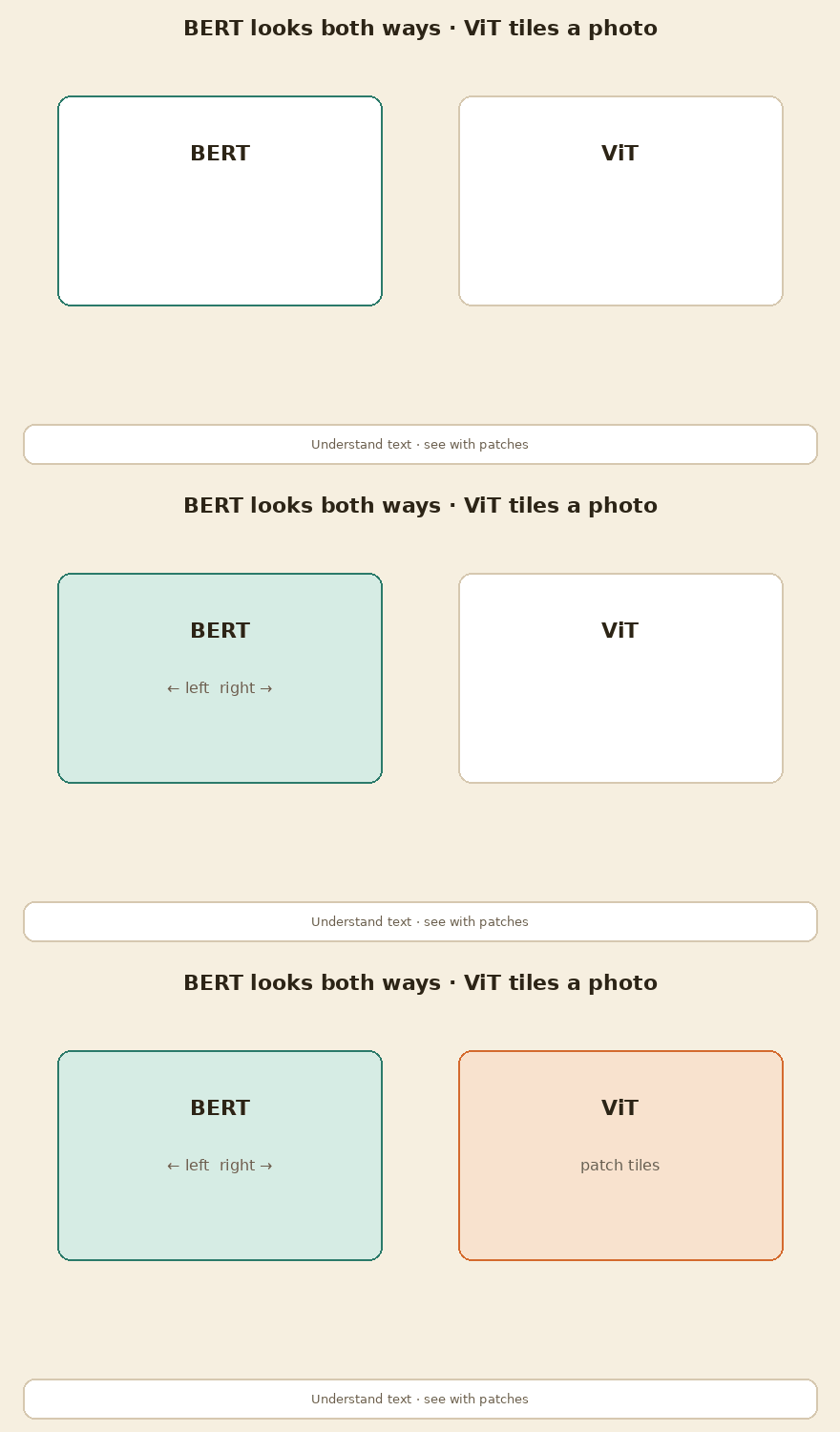
BERT is an encoder transformer. It looks left and right.
It is good at understanding: search, classify, fill blanks. It is not the usual “write an essay” model by itself.
In one line: read the whole sentence before you judge one word.
Quick easy read
What it is
- A Transformer that reads both ways (bidirectional), then gets fine-tuned for a job.
- Pre-training games: hide a word and guess it; sometimes guess if sentence B really follows sentence A.
- After that, a thin extra head can do search ranking, sentiment, span answers, and similar “understand this text” work.
Why people care
- For years this was the default way to make text features for products: classify a ticket, match a query, tag a span.
- It showed that one pretrained encoder plus a little extra training beats many custom architectures.
- Chat models that write usually use decoder stacks. BERT is the “read the ticket first” cousin.
Simple picture
Someone covers one word in a sentence and asks you to guess it — but you already saw the words on both sides. That is the fill-in-the-blank game BERT practised at huge scale.
Links: Paper (ACL Anthology) · arXiv · Pretraining corpus: English Wikipedia dumps (BERT used text passages, not lists/tables) · BooksCorpus source paper (Zhu et al., 2015) (the original BookCorpus dump is not a simple public download today)
Box 4 — Eyes for transformers
ViT (Vision Transformer)
Longer guide → more detail without grinding the PDF
Chop a picture into little patches, like stamp tiles. Treat each tile like a “word.” Run a transformer.
In one line: a photo becomes a strip of tiles, then attention reads the strip.
Quick easy read
What it is
- Same Transformer engine as text, pointed at images.
- Cut the photo into a grid of squares (often 16×16 pixels). Each square is a token.
- Train big, then transfer to smaller picture jobs. The paper’s headline result is image classification at scale.
Why people care
- You do not need a special “vision-only” backbone if you have enough data and compute.
- The same attention story now covers pixels and words — handy when a product mixes both.
- It is the clean “eyes” box on this tray: one idea, not a zoo of convolution tricks.
Simple picture
Take a poster, cut it into postage stamps, line the stamps up like a sentence, and let attention read the sentence. A cat’s ear tile looks at the whisker tiles and decides “cat.”
Links: Paper — Dosovitskiy et al. (arXiv) · Dataset: ImageNet (ViT pretrains on large labelled photo sets such as ImageNet-21k, then transfers to ImageNet-style tests; access is for research, not a random public zip)
Box 5 — An open language recipe
LLaMA
Longer guide → more detail without grinding the PDF
LLaMA (Meta) shared a strong large language model recipe with the research world. Many later open models follow the same shape.
In one line: a published cookbook for large language models, not a magic spell.
Quick easy read
What it is
- A family of decoder Transformers (7B to 65B in the first paper) trained on a lot of public text.
- Meta showed you can get strong results without a secret private corpus as the whole story.
- The recipe leaked into a thousand later models: same-shaped stacks, same “open weights + paper” habit.
Why people care
- Engineers can read a real training recipe, not only an API card.
- Smaller LLaMA-13B beating much bigger GPT-3 on many tests was the “wait, data and tokens matter” moment.
- If you ship on open weights, you will meet this family tree.
Simple picture
Not a magic spell. A published cookbook: flour, water, oven time. Other kitchens copy the loaf shape and change the toppings.
Links: Paper — Touvron et al. (arXiv) · Code / model card (Meta Llama GitHub) · Hugging Face LLaMA docs
Box 6 — Teach it to listen
A raw LLM can ramble. People want it to follow instructions and be useful. These two papers sit in one box.
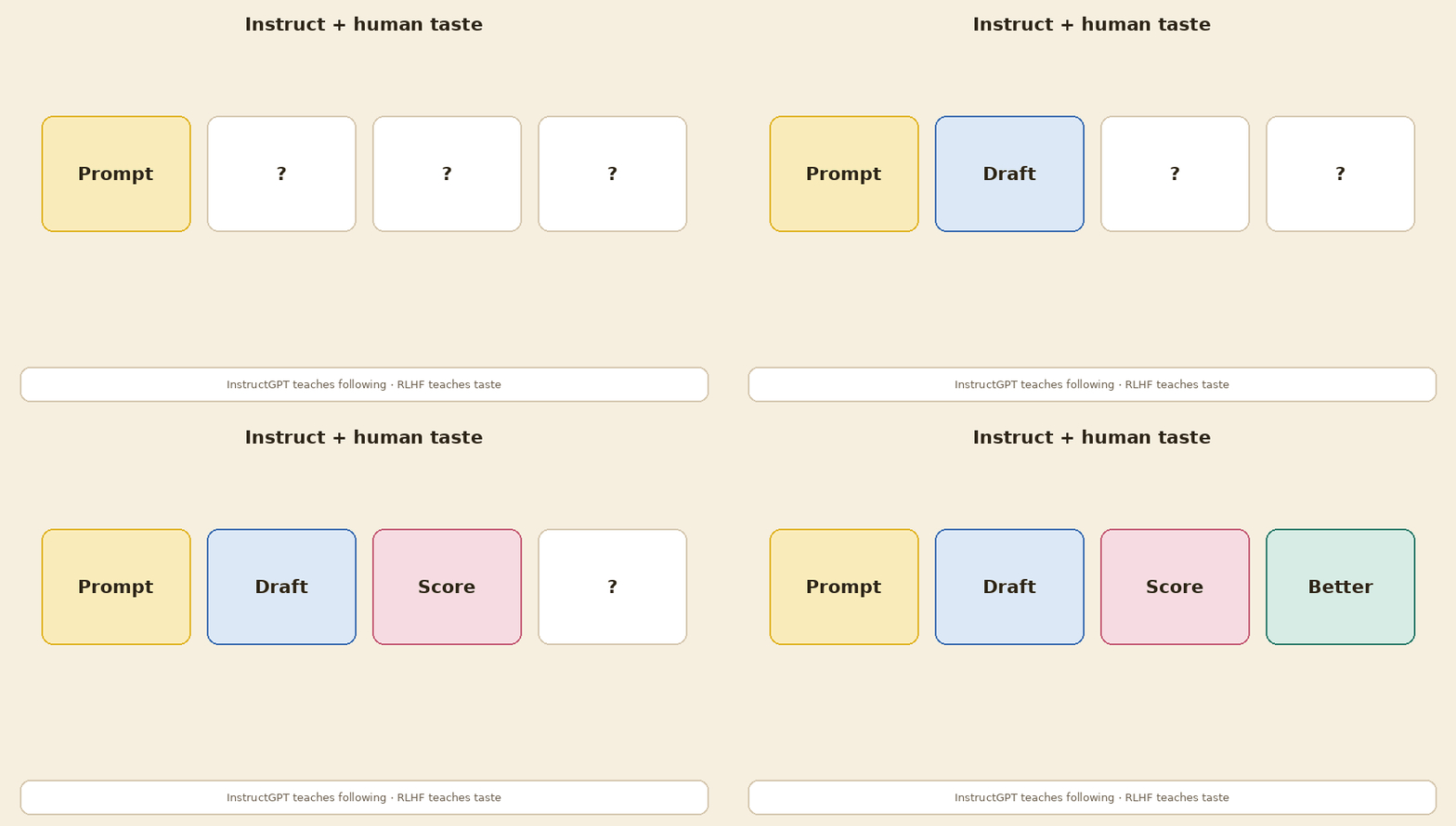
flowchart LR
  P[Prompt] --> M[Model draft]
  M --> H[Human preference]
  H --> M2[Better model]
Read when: you care why chatbots feel polite and useful.
InstructGPT
Longer guide → more detail without grinding the PDF
InstructGPT: train / tune so the model follows prompts better. The OpenAI paper that named the chat-style habit: supervised demos, then preference training.
Quick easy read
What it is
- Start from a big pretrained model (here: GPT-3).
- Step 1: humans write good answers to prompts. Train on those (supervised fine-tune).
- Step 2: humans rank model answers. Train a reward model, then move the policy toward the ranks (RLHF).
- The 1.3B InstructGPT was often preferred to 175B GPT-3 on their prompt set — size is not the same as “does what I asked.”
Why people care
- This is why “write a polite email” works better than raw next-token dump.
- In products you meet this as alignment, safety filters, and “the model got nicer after we collected ranks.”
- Later chat models reuse the same three-step skeleton, with extra tricks.
Simple picture
A junior first copies marked homework (demos). Then a reviewer points at two answers: “this one, not that one.” The junior practises toward the pointing finger, not toward a written rulebook.
Links: Paper — Ouyang et al. (arXiv)
RLHF
Longer guide → more detail without grinding the PDF
RLHF: humans (or preference data) score answers; the model moves toward better preference.
InstructGPT uses RLHF. The older landmark is Christiano et al.: teach an agent from human preference instead of a hand-written reward.
Quick easy read
What it is
- You often cannot write a perfect score function for “be helpful” or “do a backflip nicely.”
- Show a human two clips (or two answers). They pick a winner.
- Fit a reward model to those picks. Train the agent with RL on that reward.
- InstructGPT is the language-model version of this loop.
Why people care
- Taste, tone, and “don’t be rude” are preference problems, not unit tests.
- This is the named method behind a lot of chat fine-tunes — and behind a lot of later debate about whose taste got encoded.
- If you only remember one sentence: humans compare, the model climbs.
Simple picture
Two robot dance videos. You tap the less-awkward one. You never write the physics of dancing. The robot still gets better at dancing.
Links: Paper — Christiano et al. (arXiv) · Language-model version: InstructGPT
Box 7 — Cheap fine-tuning
Full fine-tuning touches all the weights. That is expensive.
PEFT is the family name. LoRA is the small-update trick most teams actually ship.
LoRA
Longer guide → more detail without grinding the PDF
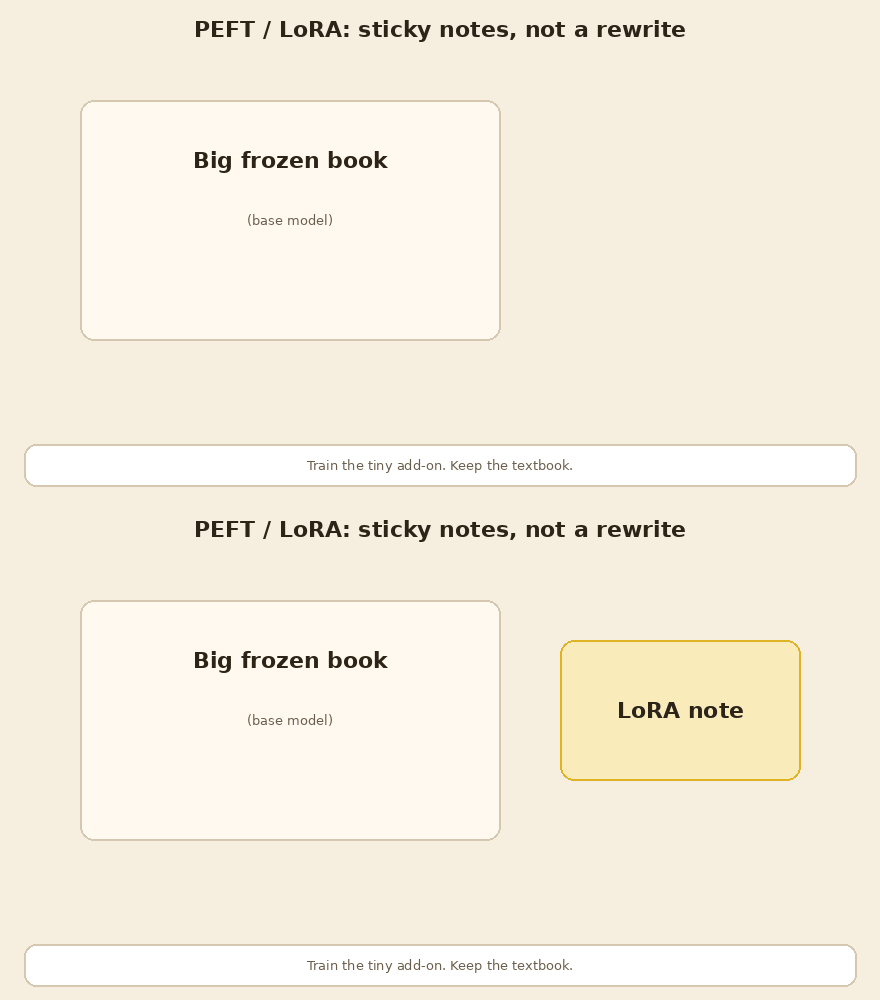
LoRA = freeze the big model; train tiny low-rank add-ons.
In one line: keep the whole textbook; only rewrite a sticky note.
Quick easy read
What it is
- Leave the pretrained weights frozen.
- Beside some big matrices (often attention projections), train two thin matrices whose product is a small “update.”
- At serve time you can merge that update back in, so you do not pay extra latency like some older adapter stacks.
Why people care
- One base checkpoint, many cheap specialist patches (support tone, internal jargon, a tool habit).
- Disk and GPU memory stay sane. You are not storing 13 copies of a 13B model.
- This is the default “we fine-tuned it” in a lot of real stacks.
Simple picture
A huge printed textbook stays on the shelf. You teach a new course by sticking a few notes on the hard pages. Swap the notes; the book stays.
Links: Paper — Hu et al. (arXiv)
PEFT
Longer guide → more detail without grinding the PDF
PEFT = Parameter-Efficient Fine-Tuning. Not one paper. A family: LoRA, adapters, prompt/prefix tuning, and friends.
Use LoRA unless you have a reason not to. Treat the rest as “know why it exists.”
Quick easy read
What it is
- Same job as full fine-tune: specialise a strong base model.
- Change only a small set of extra numbers (or a small add-on), not every weight.
- Adapters (Houlsby et al.) were an early member: tiny bottleneck layers slid into a frozen BERT. LoRA later became the popular low-rank version.
- Hugging Face PEFT is the library most engineers actually import.
Why people care
- Full copies of a 70B model per customer task do not fit a budget.
- You can keep one frozen backbone and hot-swap skills, like plugins.
- If someone says “we did PEFT,” ask which method. Often they mean LoRA.
Simple picture
The library building stays put. Each new subject gets a thin pamphlet, not a second building.
Links: Hugging Face PEFT docs · LoRA paper · Adapter paper — Houlsby et al. (arXiv) · PMLR / ICML version · Google Research page
Box 8 — Sparse giants
MoE (Mixture of Experts)
Longer guide → more detail without grinding the PDF
Instead of one huge network always on, keep many expert networks. For each token, wake only a few.
In one line: many specialists; only the right ones stand up.
This box’s primary paper is Switch Transformers (Fedus, Zoph, Shazeer): a Transformer MoE that routes each token to one expert. The older root is Shazeer et al. 2017 (sparsely-gated MoE).
Quick easy read
What it is
- A dense model uses all of its weights for every token. An MoE keeps a roster of expert feed-forward blocks.
- A small router picks which expert(s) see this token.
- Switch: pick one expert (simpler, cheaper communication than older top-k MoE).
- You can grow parameter count a lot without growing compute per token as fast.
Why people care
- This is how some “trillion parameter” language models stay runnable: most experts sleep.
- Same bill of GPU-time, more capacity — if routing stays healthy (load balance is the engineering tax).
- If a vendor says “sparse model,” they often mean this lunch box.
Simple picture
A hospital with many specialists. The triage nurse sends you to one doctor. The other doctors keep working on other patients. You do not call the whole staff for a sore throat.
Links: Primary paper — Switch Transformers (arXiv) · Lineage — Shazeer et al., sparsely-gated MoE (arXiv) · C4 corpus (defined in the T5 paper) (Switch pretrains on the Colossal Clean Crawled Corpus)
Box 9 — Look it up first
RAG (Retrieval-Augmented Generation)
Longer guide → more detail without grinding the PDF
Models forget and hallucinate. RAG fetches fresh notes from your files / search, then asks the model to answer with those notes.
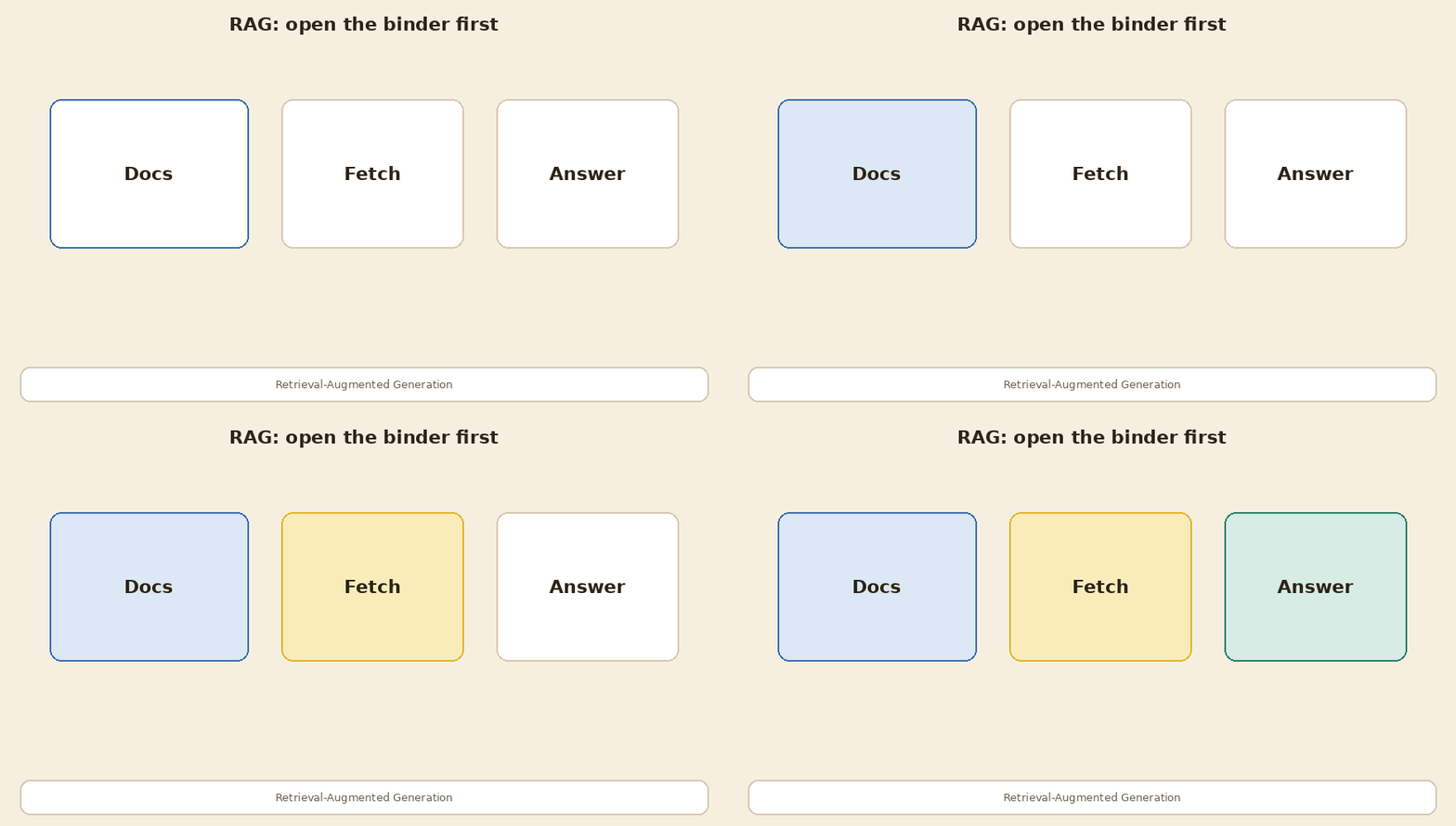
In one line: open the binder before you answer.
Quick easy read
What it is
- Two memories: the weights (what the model already “knows”) and a search index (notes you can update).
- At question time: retrieve a few passages, then generate an answer conditioned on those passages.
- Lewis et al. used a seq2seq generator plus a dense index of Wikipedia.
- Today’s product RAG is the same sandwich: retrieve → stuff into the prompt → generate. The 2020 paper is the named origin.
Why people care
- You can fix facts by editing documents, not by retraining a 70B model.
- Provenance: you can point at the paragraph you used.
- This is the usual engineering answer to “the model made up a policy.”
Simple picture
Open-book test. You grab three photocopies from the binder, then write. Closed-book is hoping you memorised the binder.
Links: Paper — Lewis et al. (arXiv) · Retrieval corpus: Wikipedia dumps (the paper indexes Wikipedia passages)
Box 10 — Picture makers (classic)
Two older ways to make pictures. Diffusion (next box) mostly won the “pretty image from a prompt” race. These two still matter for the maths and for latent spaces.
GANs
Longer guide → more detail without grinding the PDF
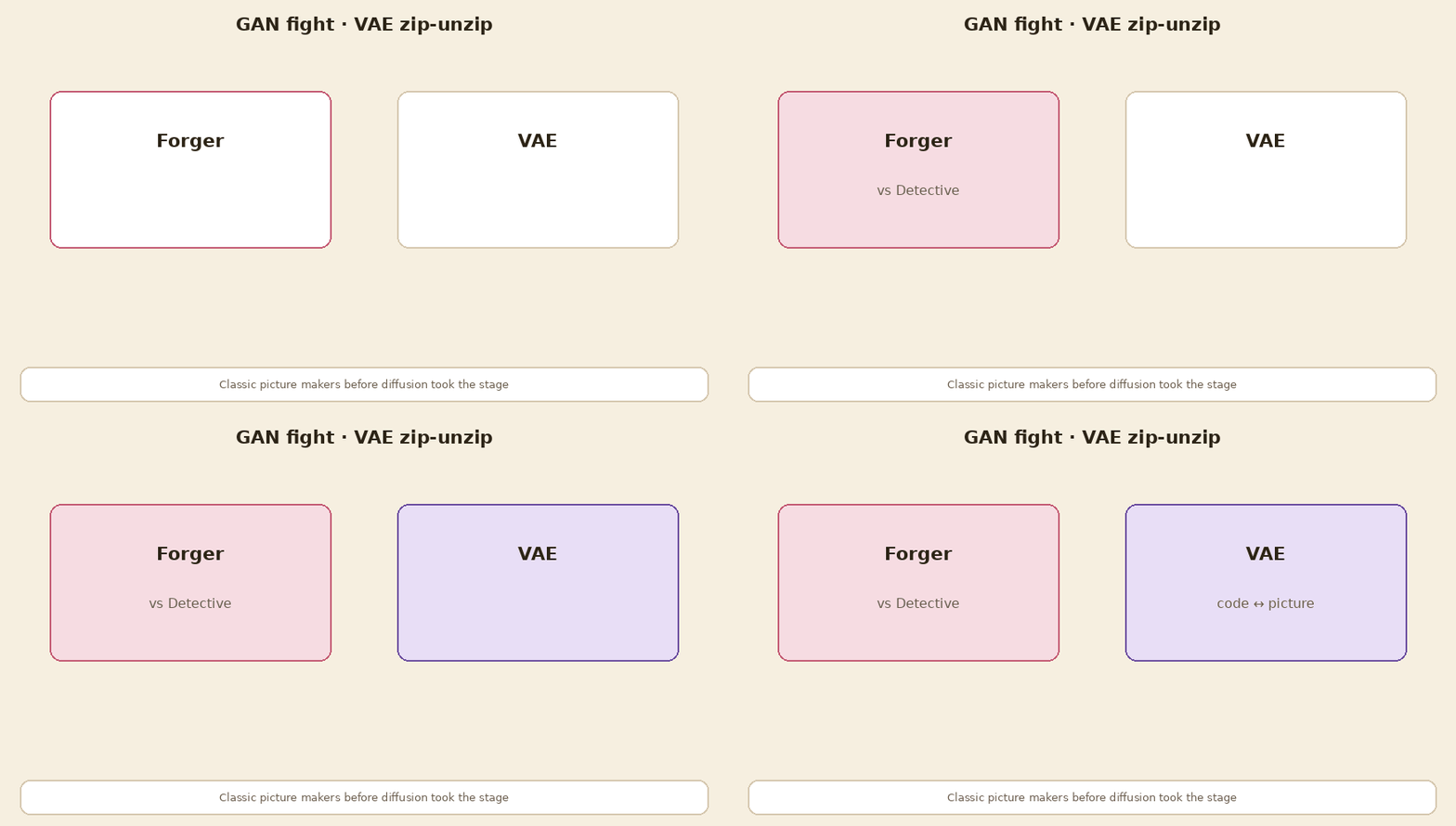
GAN: a forger and a detective. The forger gets better until fakes fool the detective.
Quick easy read
What it is
- Two nets train together: a generator makes fakes from noise; a discriminator says real vs fake.
- The generator’s job is to fool the discriminator. That fight is the training signal.
- Goodfellow et al. (2014) is the landmark. Later years were a zoo of GAN variants.
Why people care
- First time many people saw sharp generated photos, not blurry averages.
- The “two players” idea shows up in other training tricks (including parts of modern image stacks).
- History box: know it so you know what diffusion replaced in products.
Simple picture
Art forger vs museum detective. Every week the forger studies what got caught. The paintings get scarily good. Nobody wrote “draw a cat” as a loss; the fight was enough.
Links: Paper — Goodfellow et al. (arXiv) · Dataset used in the paper: CIFAR-10
VAE
Longer guide → more detail without grinding the PDF
VAE: squeeze an image into a small code, then rebuild. Good for smooth “latents.”
In one line: art contest (GAN) vs zip-and-unzip (VAE).
Quick easy read
What it is
- An encoder maps a picture to a small cloud of numbers (a latent).
- A decoder rebuilds the picture from a sample of that cloud.
- The training deal: rebuild well, but keep the cloud simple (usually “look like a standard bell curve”).
- Kingma & Welling (2013/14) is the landmark variational autoencoder.
Why people care
- Latent spaces you can walk through: morph one face toward another.
- Modern image generators still compress with a VAE-like autoencoder, then do the fancy work in that smaller space (see Diffusion).
- If someone says “latent,” this is the zip-file intuition.
Simple picture
Stuff a poster into a tiny envelope of numbers, then unpack it. Nearby envelopes unpack into similar posters. That neighbourhood is the latent space.
Links: Paper — Kingma & Welling (arXiv)
Box 11 — Picture makers (now)
Diffusion (Stable Diffusion lineage)
Longer guide → more detail without grinding the PDF
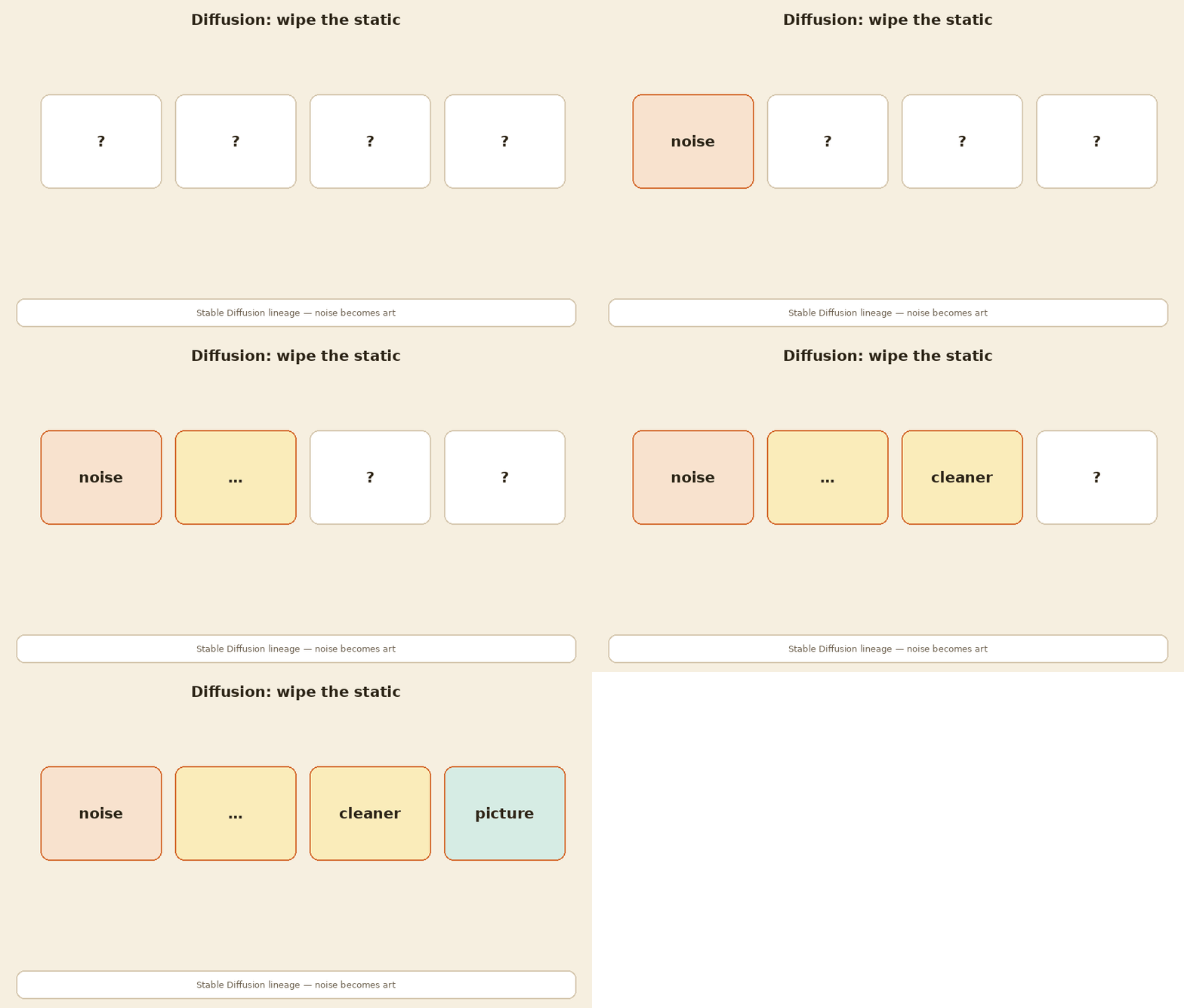
Start with TV static. Step by step, remove noise until a clean picture appears. Modern image models lean hard on this idea (often with a VAE latent space).
In one line: messy chalk → wipe carefully → drawing.
Quick easy read
What it is
- DDPM (Ho, Jain, Abbeel): add noise to real photos until they are static; train a net to undo one noise step. Repeat the undo until you have a picture.
- Latent Diffusion (Rombach et al.): do that denoising in a small latent grid from an autoencoder, not on every pixel. That is the Stable Diffusion lineage this box names.
- Text can steer the undo via cross-attention (“a red bicycle in the rain”).
Why people care
- This is how most “type words, get a picture” tools work now.
- Latent diffusion made high-res generation cheap enough to run outside a giant lab.
- Same “iterative cleanup” idea later jumped to audio and video.
Simple picture
A dusty chalkboard. You do not draw the cat in one stroke. You wipe a little dust, then a little more, until the cat is there. Start from a blank dusty board (pure noise) and wipe toward the prompt.
Links: DDPM — Ho et al. (arXiv) · Latent Diffusion / Stable Diffusion lineage — Rombach et al. (arXiv) · LAION-400M (text-to-image training in the LDM paper) · LAION-400M project page · MS-COCO (eval set in that paper)
Suggested reading order (busy people)
- Attention Is All You Need — the engine
- BERT or skim a LLaMA overview — understand vs generate
- RoPE (short) — position
- InstructGPT + RLHF — why chat feels aligned
- LoRA / PEFT — how you customise cheaply
- RAG — how products stay factual
- MoE — how giants stay fast enough
- ViT — same engine, eyes
- VAE → Diffusion (and peek at GANs for history)
You do not need all 14 in one weekend.
Honest caveats
- A common list is a map, not a PhD.
- Paper titles evolve (RAG stacks, diffusion variants, LLaMA versions). Learn the idea, then check the latest version.
- Dataset links are only where a public corpus is clearly named in the landmark paper. Some famous training sets (InstructGPT ranks, original BookCorpus dumps) are not a clean public zip.
- More lists may exist — this post only teaches these fourteen.
Sources
Official abstracts and resources used in this post (prefer these over roundups):
- Vaswani et al., Attention Is All You Need
- Su et al., RoFormer: Enhanced Transformer with Rotary Position Embedding
- Devlin et al., BERT (arXiv); Wikipedia dumps; BooksCorpus via Zhu et al.
- Dosovitskiy et al., An Image is Worth 16×16 Words; ImageNet
- Touvron et al., LLaMA: Open and Efficient Foundation Language Models; Meta Llama GitHub
- Ouyang et al., Training language models to follow instructions with human feedback
- Christiano et al., Deep Reinforcement Learning from Human Preferences
- Hu et al., LoRA: Low-Rank Adaptation of Large Language Models
- Hugging Face PEFT; Houlsby et al., Parameter-Efficient Transfer Learning for NLP
- Fedus, Zoph & Shazeer, Switch Transformers; Shazeer et al., Sparsely-Gated Mixture-of-Experts
- Lewis et al., Retrieval-Augmented Generation for Knowledge-Intensive NLP Tasks
- Goodfellow et al., Generative Adversarial Nets
- Kingma & Welling, Auto-Encoding Variational Bayes
- Ho et al., Denoising Diffusion Probabilistic Models; Rombach et al., Latent Diffusion Models
Takeaway
Fourteen famous papers sit in a handful of lunch boxes: the transformer engine, position, deep reading, vision tiles, open LLM recipes, instruction plus human preference, cheap adapters, sparse experts, retrieval, and three ways to make pictures. Learn the box on this map, open the longer guide if you want more detail, then open the paper.
If this helped:

Discussion
Reactions and replies via GitHub Discussions. Sign in with GitHub to comment.