Semantic Caching for RAG & LLMs: Remembering by Meaning
If a teammate asks “Where is the sprint dashboard?” you paste the link. Five minutes later someone asks “Can you share the sprint board URL?” you do not rebuild the dashboard. You reuse the answer.
Now the same pattern in a company assistant:
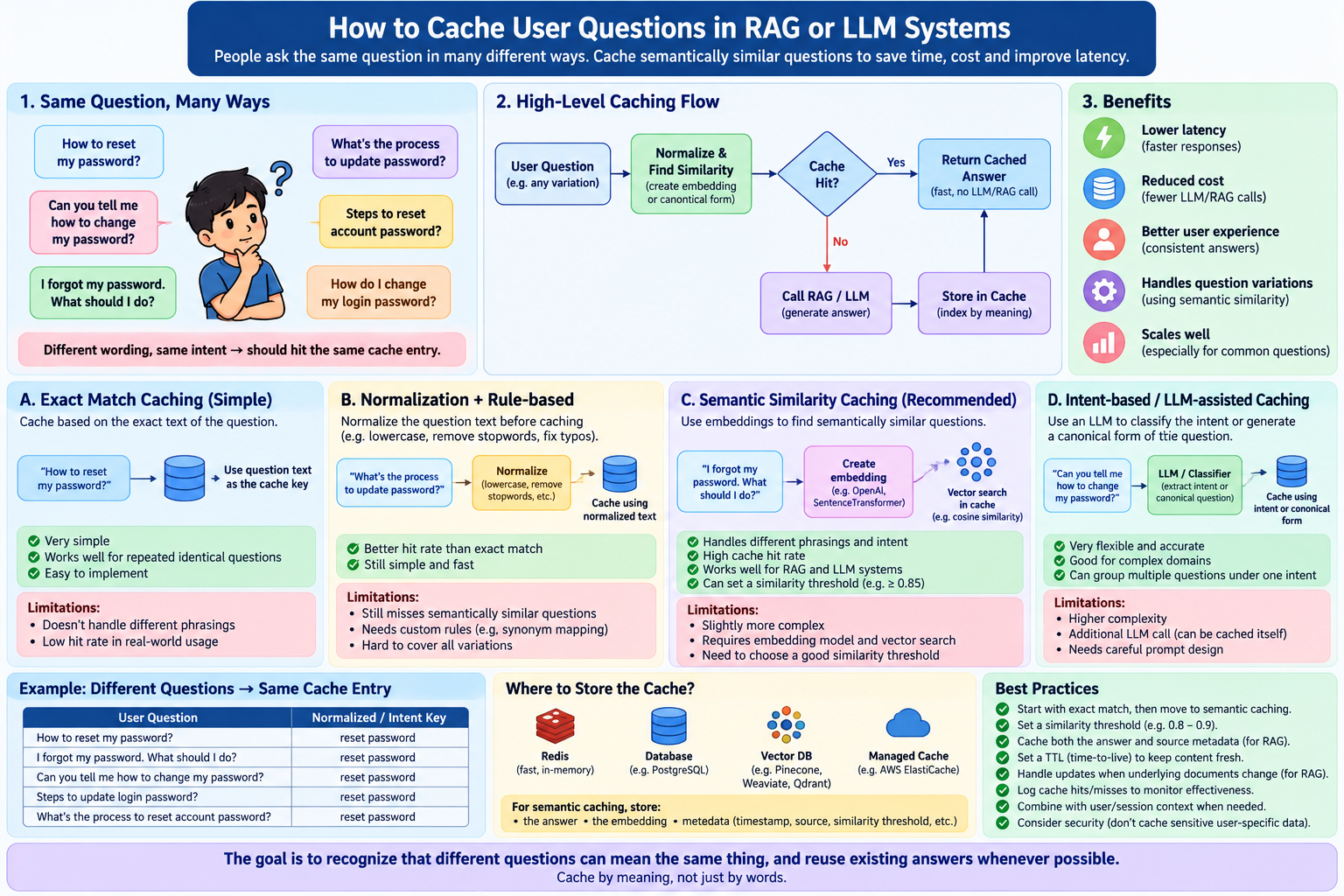
“How do I reset my password?” “I forgot my password. What should I do?” “Can you tell me how to change my password?”
A human hears one intent. A string-keyed cache hears three misses — and pays for embedding, retrieval, rerank, and a full LLM call each time.
Semantic caching means: have I already answered a sufficiently similar question, and is it still safe to reuse that answer?
This is the third post in the series. PEFT changes weights. Agent memory remembers a user or a past attempt. A semantic cache remembers work already done. Do not collapse those three into one Pinecone index.
Also in this series: PEFT, LoRA, and QLoRA · AI agent memory · Semantic caching (this post)
Who this is for — and when to use it
You already cache GET /users/42. This post is what changes when the key is English.
Use a semantic cache when:
- Traffic repeats the same intents (FAQs, policy, “how do I…”) with different wording.
- The miss path is expensive: retrieval + large prompt + LLM.
- Answers are stable enough to reuse: docs, runbooks, product FAQs.
Do not cache (or isolate hard) when the correct answer depends on:
- Who is asking (balance, invoices, “my” anything)
- When (prices, Bitcoin, “today’s” incident status)
- Which tenant (Company A’s SSO ≠ Company B’s SSO)
- Which role (intern vs admin runbook)
- Fast-changing source docs with no invalidation story
Build order: exact match → normalisation → embedding similarity + metadata filters → only then an intent model. Do not call a large LLM to decide whether you can skip a large LLM.
Terms
| Term | Meaning | Developer analogy |
|---|---|---|
| Cache / hit / miss | Stash of finished work; found vs must recompute | Note on the desk vs rereading the wiki |
| Semantic | About meaning, not spelling | user_id and customer_id can be the same person |
| Semantic cache | Reuse an answer when a new question is close enough in meaning | Senior who hears three phrasings of “Wi-Fi died” |
| Exact-match cache | Key = exact string | Terminal up-arrow |
| Normalisation | Lowercase, trim, strip punctuation | Running Prettier before diff |
| Embedding / vector | Numbers that locate a sentence in meaning-space | Coordinates on a map with hundreds of axes |
| Cosine similarity | How aligned two vectors are (1 same direction, 0 orthogonal) |
Two arrows pointing at the same box on the diagram |
| Threshold | Minimum score to count as a hit | How close is “close enough”? |
| Canonical form | Official wording of an intent | One git command instead of ten aliases |
| RAG / LLM | Retrieve docs then generate / the generator itself | Search the wiki, then the expensive senior writes |
| TTL / invalidation | Expiry / actively dropping stale entries | Milk date / DevOps changed the staging IP |
| Multi-tenancy | Shared infra, isolated data | One building, locked apartments |
Why your Redis instincts fail
Classic cache:
GET /api/v1/users/42/profile
key == key  →  hit
Natural language:
"How do I reset my password?"
    ==
"I forgot my password. What should I do?"
    →  false
A miss in a CRUD app is often a cheap SQL round-trip. A miss in RAG is a pipeline:
%%{init: {"theme": "base", "themeVariables": {"fontSize": "14px"}, "flowchart": {"nodeSpacing": 20, "rankSpacing": 30}}}%%
flowchart TD
    Q["User question"]
    EMB["Embed query"]
    VEC["Vector search over chunks"]
    RERANK["Optional rerank"]
    PROMPT["Build large prompt"]
    LLM["LLM generation"]
    ANS["Answer"]

    Q --> EMB --> VEC --> RERANK --> PROMPT --> LLM --> ANS

    style Q fill:#E3F2FD,stroke:#1E88E5,color:#333
    style EMB fill:#FFF3E0,stroke:#FB8C00,color:#333
    style VEC fill:#FFF3E0,stroke:#FB8C00,color:#333
    style RERANK fill:#FFF3E0,stroke:#FB8C00,color:#333
    style PROMPT fill:#F3E5F5,stroke:#8E24AA,color:#333
    style LLM fill:#FFEBEE,stroke:#E53935,color:#333
    style ANS fill:#E8F5E9,stroke:#43A047,color:#333
Exact timings and dollar costs depend on model, prompt size, and vendor. What does not depend on a blog post’s imagination: generation dominates latency and cost; a cache hit that skips retrieval + generation is usually orders of magnitude cheaper. Measure yours.
A junior treats “clone the repo” and “download the code” as different tickets. A senior reuses git clone …. Semantic caching is that senior’s pattern, automated.
Four levels — cheapest first
The overview figure shows the same ladder. You do not need level 4 on day one.
%%{init: {"theme": "base", "themeVariables": {"fontSize": "14px"}, "flowchart": {"nodeSpacing": 20, "rankSpacing": 30}}}%%
flowchart TD
    subgraph S1 ["Level 1: Exact match"]
        L1["Key = exact question string"]
    end
    subgraph S2 ["Level 2: Normalisation"]
        L2["Key = cleaned string"]
    end
    subgraph S3 ["Level 3: Semantic similarity"]
        L3["Key = embedding + nearest neighbour"]
    end
    subgraph S4 ["Level 4: Intent / canonical"]
        L4["Key = intent id or canonical question"]
    end

    L1 -->|new phrasing misses| L2
    L2 -->|synonyms miss| L3
    L3 -->|subtle extra constraints| L4

    style L1 fill:#E3F2FD,stroke:#1E88E5,color:#333
    style L2 fill:#FFF3E0,stroke:#FB8C00,color:#333
    style L3 fill:#E8F5E9,stroke:#43A047,color:#333
    style L4 fill:#F3E5F5,stroke:#8E24AA,color:#333
Level 1 — Exact match (terminal up-arrow)
Key:   "How to reset my password?"
Value: "Go to Settings → Security → Reset Password…"
| Pros | Cons |
|---|---|
| Fastest, simplest, no wrong-meaning hits | One extra space or capital and you miss |
| Perfect when users paste the same FAQ title | Conversational traffic rarely repeats strings |
Ship this first. It is free correctness.
Level 2 — Normalisation (the linter)
Before lookup: lowercase, strip punctuation, collapse whitespace, maybe drop stopwords.
"HOW DO I RESET PASSWORD???"  →  "how do i reset password"
"Reset password!!!"           →  "reset password"   (if you drop stopwords)
| Pros | Cons |
|---|---|
| Still a string compare; still cheap | "forgot login credential" will not become "reset password" |
| Catches shouting / punctuation | Hand-built synonym lists become a junk drawer |
Useful. Not sufficient.
Level 3 — Semantic similarity (the usual production step)
Embed the question. Search previous questions by cosine (or equivalent). If the neighbour clears your threshold and metadata matches, reuse the payload.
%%{init: {"theme": "base", "themeVariables": {"fontSize": "14px"}, "flowchart": {"nodeSpacing": 20, "rankSpacing": 30}}}%%
flowchart LR
    Q["New question"] --> EMB["Embed"]
    EMB --> SIM{"Similar enough\nand same scope?"}
    SIM -->|yes| HIT["Return cached payload"]
    SIM -->|no| MISS["RAG + LLM, then write cache"]

    style Q fill:#E3F2FD,stroke:#1E88E5,color:#333
    style EMB fill:#FFF3E0,stroke:#FB8C00,color:#333
    style SIM fill:#F3E5F5,stroke:#8E24AA,color:#333
    style HIT fill:#E8F5E9,stroke:#43A047,color:#333
    style MISS fill:#FFEBEE,stroke:#E53935,color:#333
You need an embedding model and a place that can do nearest-neighbour search (pgvector, a vector DB, Redis-with-vectors, etc.). Threshold is a product decision, not a universal 0.85.
Level 4 — Intent / canonical form
A classifier or small model maps many phrasings onto identity.password.reset. Powerful for closed domains. The trap:
If the goal is to skip an expensive LLM, do not spend most of that cost on the cache lookup.
Use a tiny classifier, or only run this on misses / ambiguous neighbours. For most RAG FAQs, level 3 plus metadata is enough.
Embeddings and cosine, without the fog
An embedding model turns a sentence into a long list of numbers. Similar meanings land in similar directions.
A simple picture: rate ice-cream flavours on sweetness, fruit, and chocolate. Double chocolate and brownie swirl sit next to each other; strawberry sorbet does not. Real models use hundreds or thousands of axes you do not name by hand.
Another picture: treat each vector as an arrow from the origin.
- Same meaning → arrows almost parallel → cosine near 1
- Unrelated → about 90° → cosine near 0
- Opposite → 180° → cosine near −1
cosine(A, B) = (A · B) / (|A| |B|)
Dot product = “do we light up the same axes?” Dividing by lengths ignores “this sentence is longer” so you compare direction, not essay size. In practice, FAQ pairs you care about live in a high-positive band; you still cannot treat 0.91 as “same answer.”
Similarity is not equivalence
This is the part that burns teams.
| Question A | Question B | Similar words? | Same safe answer? |
|---|---|---|---|
| Deploy to staging | Deploy to production | Yes | No |
| Pro price today | Pro price last year | Yes | No |
| Cancel my account | Cancel and get a full refund | Yes | No |
| Reset my password | I forgot my password | Yes | Often yes |
A loose threshold raises hit rate and wrong hits. A paranoid threshold is safe and barely saves money. Pick the number with a labelled pair set, not a tweet.
How to choose a threshold (eval, not vibes)
Build a small golden set:
question_a | question_b | same_intent? | notes
Include near-miss danger pairs (staging vs prod) on purpose. Sweep thresholds:
threshold   hits on "yes" pairs    hits on "no" pairs
0.80        high                   too many
0.90        medium                 few
0.95        low                    rare
Those rows are a worksheet, not this blog’s production metrics. Your embedding model and domain will move the numbers. Prefer a low wrong-hit rate over a pretty hit-rate dashboard.
Add metadata constraints so similarity is never the only gate:
similar enough
AND tenant_id
AND role / ACL
AND product
AND knowledge_version
AND language
AND (optional) model_version / prompt_version
Rule of thumb for the key:
If changing a field could change the correct answer, that field belongs in isolation or invalidation.
Where the cache sits
In front of the expensive path. Waterfall: cheapest check first.
%%{init: {"theme": "base", "themeVariables": {"fontSize": "14px"}}}%%
sequenceDiagram
    autonumber
    actor User
    participant GW as Gateway
    participant L1 as Exact / normalised cache
    participant L3 as Vector cache
    participant RAG as RAG
    participant LLM as LLM

    User->>GW: question
    GW->>L1: string key
    alt L1 hit
        L1-->>GW: payload
        GW-->>User: cached answer
    else L1 miss
        GW->>L3: embed + search + filters
        alt semantic hit
            L3-->>GW: payload
            GW-->>User: cached answer
        else miss
            GW->>RAG: retrieve
            RAG-->>GW: chunks
            GW->>LLM: generate
            LLM-->>GW: answer
            GW->>L3: write entry
            GW->>L1: write string key
            GW-->>User: fresh answer
        end
    end
fast / cheap
  exact key
  normalised key
  embedding neighbour + metadata
  retrieve chunks
  LLM
slow / expensive
Cache the answer, or cache a step?
You can cache more than the final paragraph:
| Layer | Maps | Saves | Staleness risk |
|---|---|---|---|
| Embedding cache | exact text → vector | Repeat embed calls | Low |
| Retrieval cache | question → chunk IDs | Vector search | Docs moved |
| Response cache | question → final answer | Search + generation | Highest value, strictest freshness |
Downstream caches save more and demand better invalidation. Start with response cache for FAQs; add the others if embed or retrieval shows up on the bill.
What to store
Do not store only the string answer. RAG answers need to be auditable and killable.
{
  "cache_id": "…",
  "question": "How do I reset my password?",
  "canonical_question": "How do I reset my account password?",
  "embedding": [0.01, -0.04],
  "answer": "Settings → Security → Reset Password, then use the email link.",
  "citations": [
    { "document": "security_handbook.pdf", "page": 14, "chunk_id": "sec_908" }
  ],
  "tenant_id": "acme",
  "role": "employee",
  "model": "…",
  "prompt_version": "v3.2",
  "knowledge_version": "kb_v48",
  "created_at": "2026-09-07T01:30:00Z",
  "ttl_expires_at": "2026-09-14T01:30:00Z"
}
The embedding array is illustrative (two floats, not a real dimension). Persist citations so a user can ask “where did this come from?” and so you can purge by chunk_id when that file changes.
Model / prompt versions: if you ship a better system prompt tomorrow, you may not want last week’s wording. Put versions in the key or bump them to invalidate.
Invalidation (the actually hard part)
Phil Karlton’s joke still applies: cache invalidation and naming things.
Doc yesterday: lunch expense cap $25.
Doc today: $40.
Cache still says $25 until you kill it.
| Strategy | How | Tradeoff |
|---|---|---|
| TTL | Expire in N hours | Simple; stale until the timer |
| Version stamp | knowledge_version++ on any publish |
Instant global flush; may drop still-valid entries |
| Event purge | Webhook: travel_policy.md changed → delete entries that cite it |
Precise; needs citation IDs you actually stored |
Use TTL as a backstop even if you have events.
Security: never serve Alice’s answer to Bob
Alice: "What's my account balance?"  →  $4,200
Bob:   "How much money do I have?"   →  cosine looks great
Naive cache: "Your balance is $4,200"
Rules:
- Do not globally cache personal questions. Detect first-person finance / HR / “my ticket” and skip or scope to
user_idwith a short TTL. - Filter by tenant and role before similarity. Neighbour search inside a namespace, not across the whole SaaS.
- Same string, different tenant — Company A and Company B both ask “How do I configure SSO?” and must not share an entry.
Isolation is part of the key, not a later patch.
Where to put the bytes
Brand is secondary. You need low-latency get-by-key and nearest neighbour over question embeddings, plus metadata filters.
| Tool | Fits |
|---|---|
| Redis (and cloud siblings) | L1/L2, TTL, session-ish exact keys |
| Postgres + pgvector | One box you already run; relational metadata + vectors |
| Dedicated vector DBs (Qdrant, Weaviate, Pinecone, Milvus, …) | Large neighbour-search volume, HNSW-style indexes |
Start where the rest of the app already lives.
Semantic cache vs RAG vs agent memory
| RAG | Agent memory | Semantic cache | |
|---|---|---|---|
| Asks | What docs are relevant? | What do I know about this user / past attempt? | Did we already answer this intent? |
| Store | Chunks | Profile, episodes, skills | Question + payload |
| Hit means | Better grounded generation | Personalised or experienced agent | Skip the pipeline |
Memory: “Vijay prefers TypeScript.”
Cache: “The Docker restart command is sudo systemctl restart docker — anyone can reuse that.”
When semantic caching is a bad idea
Skip or tightly scope if answers depend on:
- live prices, inventory, incidents
- account state or identity
- permissions you cannot encode in the key
- docs that change hourly with no hook
- highly personalised context (the retrieved memory is the answer)
“What’s Bitcoin at?” and “What’s my balance?” are the two exam questions. If your cache cannot fail those, do not turn it on.
How to know it worked
A high hit rate with wrong answers is a regression, not a win.
Track at least:
- requests, L1 hits, L3 hits, misses
- similarity score histogram
- false hits (sampled or from the golden set)
- LLM/RAG calls avoided
- latency on hit vs miss
- estimated cost avoided (from your billing, not a template)
Consistency is a real third benefit: one hundred users asking the same policy question can get the same approved wording, not 100 LLM paraphrases. That matters for support and compliance.
Do not publish a dashboard of invented monthly savings. Instrument, then quote your week-1 numbers.
Implementation ladder
- Exact question → answer. Measure hit rate.
- Add normalisation. Measure again.
- Embeddings + threshold + eval set including danger pairs.
- Add tenant / role / knowledge version.
- Invalidate on document change (and keep TTL).
Stop when the next layer’s complexity exceeds the measured miss cost.
Takeaways
- Cache meaning, not just bytes — but only when meaning-plus-metadata implies the same safe answer.
- Cheapest check first: exact → normalised → vector → RAG → LLM.
- Threshold + isolation + invalidation are the product. The vector DB is a library.
- Store answer + citations + versions. You cannot purge what you did not tag.
- Cache ≠ memory ≠ RAG ≠ PEFT. Reused computation, remembered people, retrieved docs, changed weights.
- Start simple, measure false hits, then get fancy.
If this helped:

Discussion
Reactions and replies via GitHub Discussions. Sign in with GitHub to comment.