The Intelliwise — lunch-box note
InstructGPT — longer guide
How a pretrained model learns to follow instructions: copy good demos, then climb human preference ranks.
This is half of the “teach it to listen” box on the lunch-box map. InstructGPT is the named chat-style recipe. RLHF is the older preference engine it uses.
What problem it solves
A raw model can ramble. People want it to do what they asked, in a useful way.
A pretrained LM is a next-token engine. It will complete “how to build a bomb” or a rude rant if that looks likely. Ouyang et al. (2022) start from GPT-3 and add a three-step alignment loop so the model follows instructions on a held-out prompt set — often so well that a 1.3B InstructGPT beats 175B GPT-3 in human preference. Size is not the same as “does what I asked.”
| Symptom of a raw LM | What this paper aims at |
|---|---|
| Ignores the ask; keeps completing the genre | Follow the instruction |
| Toxic or unhelpful by default | Preferred answers on their label set |
| “Bigger is better” as the only knob | A small aligned model can win a taste test |
How the idea works
Three steps. Remember them in order.
flowchart LR
  S[SFT: copy written demos] --> R[reward model: learn ranks]
  R --> P[PPO: bump the policy]
- Supervised fine-tune (SFT). Labelers write good answers to prompts (from users + crafted sets). Train the pretrained model to imitate those answers. This already helps a lot.
- Reward model (RM). Show a labeler several model answers to the same prompt. They rank them. Fit a model that scores a
(prompt, answer)pair the way those ranks go. - RL (PPO) against the RM. Sample answers, get a reward, update the policy. Add a KL penalty so the model does not flee the pretrained language for empty high-score babble.
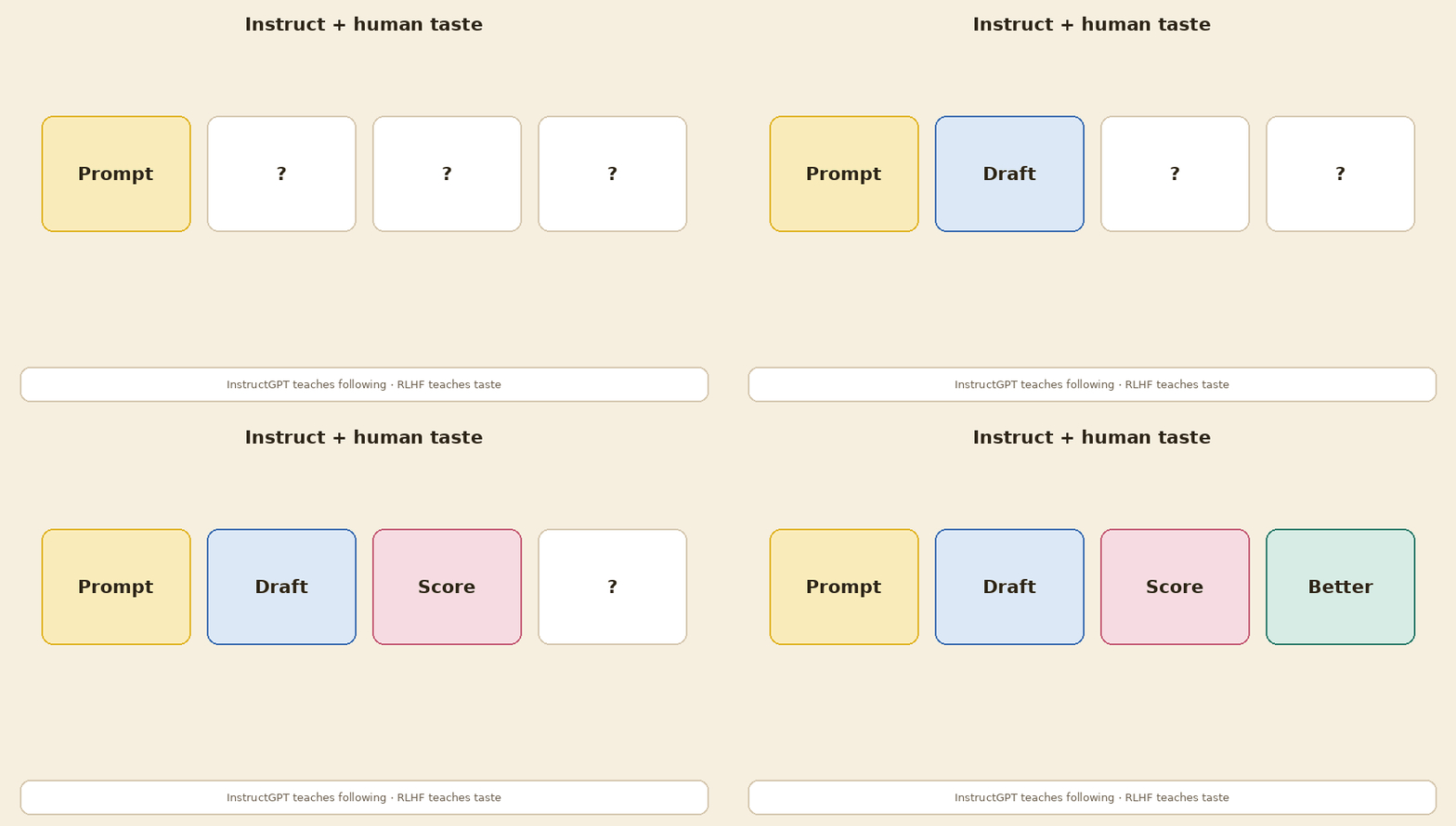
Simple picture: a junior first copies marked homework. Then a reviewer points at two answers: “this one, not that one.” The junior practises toward the finger, not toward a written rulebook.
What they measured. Labelers preferred InstructGPT to GPT-3 on their prompt distribution. The paper also talks about truthfulness and toxicity — better, not solved. Public NLP benchmarks were not the main trophy; some even moved a little the wrong way. That is part of the story: the objective was human preference on instructions, not GLUE.
Why it mattered / what it unlocked
- This is why chat UIs feel like products. “Write a polite email” is an instruction. Raw completion is a different job.
- The three-step skeleton leaked. Later “helpful assistant” models reuse SFT → preference → RL (or a simpler preference loss). Extra tricks change; the skeleton stays.
- Preference is someone’s taste. Labelers were contractors following a guide. “Aligned” here means aligned to that guide and those ranks, not to a universal moral law.
- Honesty about data. The preference ranks and demo answers are not a public dump. Do not chase an “InstructGPT dataset.zip.” The paper is the artefact.
What to remember
- SFT copies demos. RM learns ranks. RL climbs the RM. KL keeps language on a leash.
- A smaller instructed model can beat a larger raw model on “did you do the task?”
- InstructGPT uses RLHF. Christiano et al. is the older “humans compare two clips” paper.
- Safety and “don’t be rude” in products are this lunch box plus a lot of later filters.
- If you only ship prompts against an API, you still live downstream of this recipe.
When to read the real paper
Open Ouyang et al. when you want:
- labeler instructions, rank collection, and the PPO + KL details
- the 1.3B vs 175B preference plots
- what improved (following, some toxicity) and what did not (hallucination is not gone)
- the honest limits section — whose values, what they did not measure
Skip the grind if you only needed “demos, then ranks, then climb.”
Links
- Paper — Ouyang et al., arXiv 2203.02155
- Older preference engine: Christiano et al. RLHF guide · arXiv 1706.03741
No public InstructGPT preference dump. If you need a dataset, look at later open preference corpora — those are other papers, not this one.
Back on the tray: lunch-box map · RLHF · raw recipe LLaMA