The Intelliwise — lunch-box note
RLHF (Christiano et al.) — longer guide
Teach an agent from pairwise human picks when you cannot write the score function.
This is the other half of the “teach it to listen” box on the lunch-box map. InstructGPT is the language-model product form. Christiano et al. (2017) is the named origin: deep reinforcement learning from human preferences.
What problem it solves
You cannot write a perfect rule for “that was a nice backflip.” You can point at the better video.
RL needs a reward. For Atari you can use the game score. For “looks like a real backflip” or “be a helpful assistant,” a hand-written reward is either missing or a cheat the agent will game. Christiano et al. replace the written reward with a learned one, fit to humans choosing the winner of two short clips.
| If you can… | Then use… |
|---|---|
| Write a trustworthy number (game score, latency) | Ordinary RL |
| Only say “A is better than B” | This paper’s loop |
| Write a full good answer | Supervised imitation (InstructGPT’s first step) |
How the idea works
- The agent acts in an environment (here: Atari, and a simulated robot). You record short trajectory snippets.
- A human sees two snippets and picks a winner (or a rare “can’t tell”).
- Fit a reward model rθ so that preferred snippets get higher return than the losers (a Bradley–Terry-style ranking loss).
- Train the policy with RL on rθ (they use an A2C / PPO-family setup in the paper’s stack).
- Keep collecting comparisons on the current policy, or the reward model goes stale.
flowchart TB
  Pi[policy plays] --> Clips[two clips]
  Clips --> H[human pick]
  H --> RM[fit reward model]
  RM --> Pi
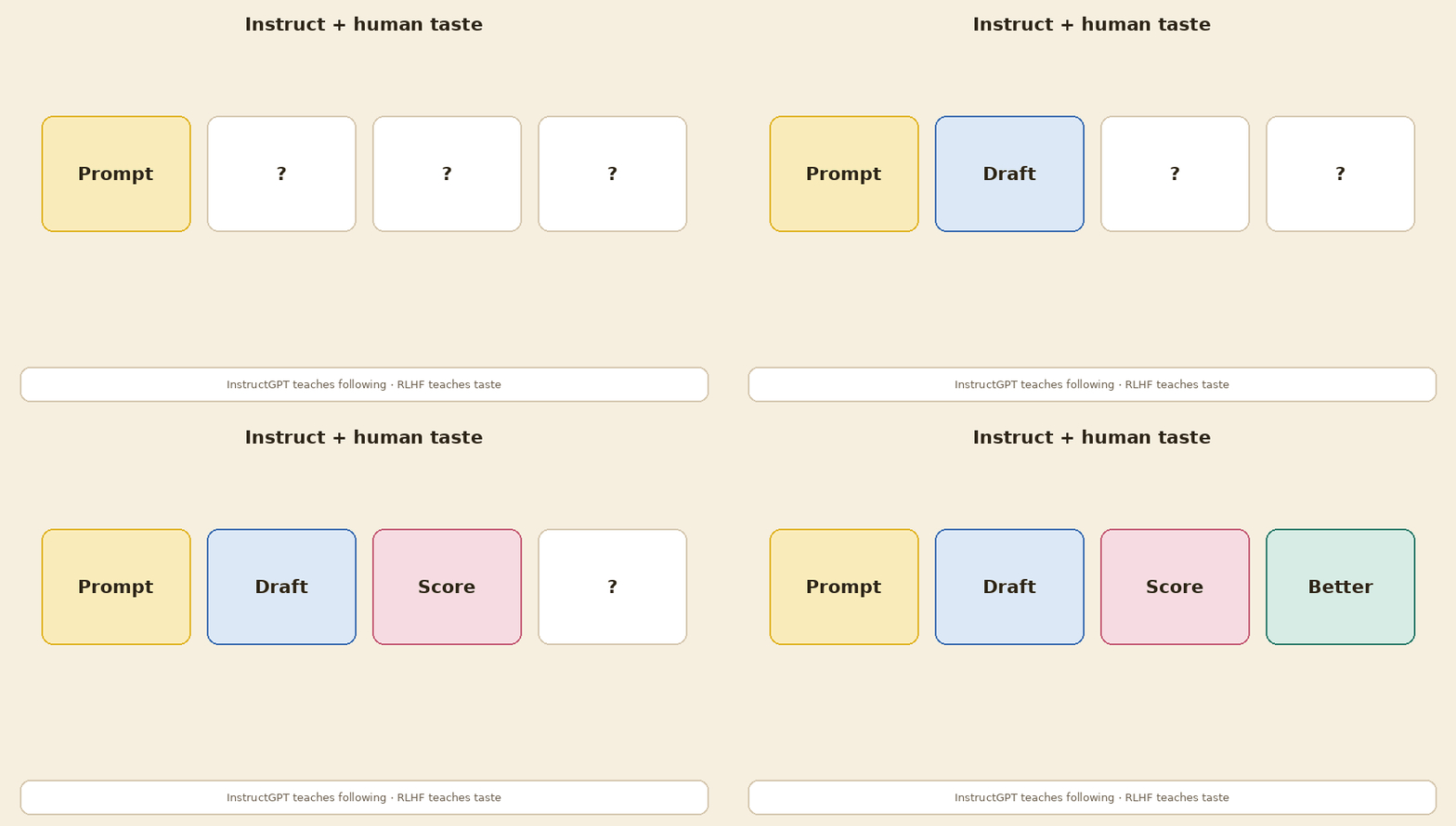
Simple picture: two robot dance videos. You tap the less-awkward one. You never write the physics of dancing. The robot still gets better at dancing.
What they showed. With surprisingly few comparison hours, agents learned Atari games and a backflip from preference, sometimes matching or beating reward-from-the-game baselines. The paper is not about GPT. It is about preference as a reward interface.
Why it mattered / what it unlocked
- A method name that stuck. “RLHF” in 2022–2024 chat papers is this loop, moved from pixels-and-joysticks to prompts-and-answers.
- Taste is a ranking problem. Tone, “don’t be rude,” “this explanation is clearer” — those are comparisons, not unit tests.
- It made the later debate possible. If the reward is a model of someone’s picks, you can ask: whose picks? how many? how gamed? That debate is downstream of this paper, not a reason to skip the idea.
- InstructGPT is the LM port. SFT + RM + PPO in Ouyang et al. is Christiano’s preference engine wearing a language-model body.
What to remember
- Humans compare two traces. A reward model fits the picks. RL climbs that model.
- Use this when the true score is “I know it when I see it.”
- The 2017 environments are games and MuJoCo-style robots, not chat.
- Preference data can be stale; the loop is online-ish, not a one-shot label dump.
- “RLHF” on a model card almost always means this box + an InstructGPT-shaped pipeline.
When to read the real paper
Open Christiano et al. when you want:
- the exact preference loss and how they query humans
- Atari / robot results and how many comparison hours they spent
- the “reward hacking” discussion — the agent will exploit a sloppy rθ
- the original figures (clip UI, learning curves)
Skip the grind if you only needed “humans compare, the model climbs,” then go to InstructGPT for the chat version.
Links
- Paper — Christiano et al., arXiv 1706.03741
- Language-model version: InstructGPT guide · Ouyang et al., arXiv 2203.02155
No public “Christiano preference dump” for these robots/Atari clips as a modern LM dataset. Do not invent one.
Back on the tray: lunch-box map · InstructGPT