The Intelliwise — lunch-box note
RAG — longer guide
Two memories: the weights, plus a search index you can edit. Retrieve, then generate.
This is the look it up first box on the lunch-box map. Lewis et al. (2020) named the sandwich. Today’s “stuff three chunks in the prompt” products are the same lunch box with a thinner generator.
What problem it solves
Open the binder before you answer.
A closed-book LM must store facts in weights. Facts go stale. The model invents a confident policy. Retrieval-Augmented Generation keeps a non-parametric memory (an index of passages you can update) and a parametric memory (the generator). At question time you fetch, then condition generation on what you fetched.
| Closed book | RAG |
|---|---|
| Hope the weight memorised it | Hope the index contains it |
| Fix a fact → retrain | Fix a fact → edit / reindex a doc |
| Hard to cite | You can point at the passage |
How the idea works
Lewis et al.’s original stack (not a 2024 vector-DB vendor slide):
- Index Wikipedia passages with a dense retriever (DPR-style: a question encoder and a passage encoder, inner product search, FAISS in the paper).
- A query is encoded. Top-k passages come back.
- A seq2seq generator (they use BART) writes the answer conditioned on the query plus those passages.
- They study a few ways to combine passages (one latent doc vs mixing several). You do not need the marginalisation algebra to steal the product idea.
flowchart LR
  Q[question] --> R[retriever]
  I[passage index] --> R
  R --> G[generator]
  Q --> G
  G --> A[answer]
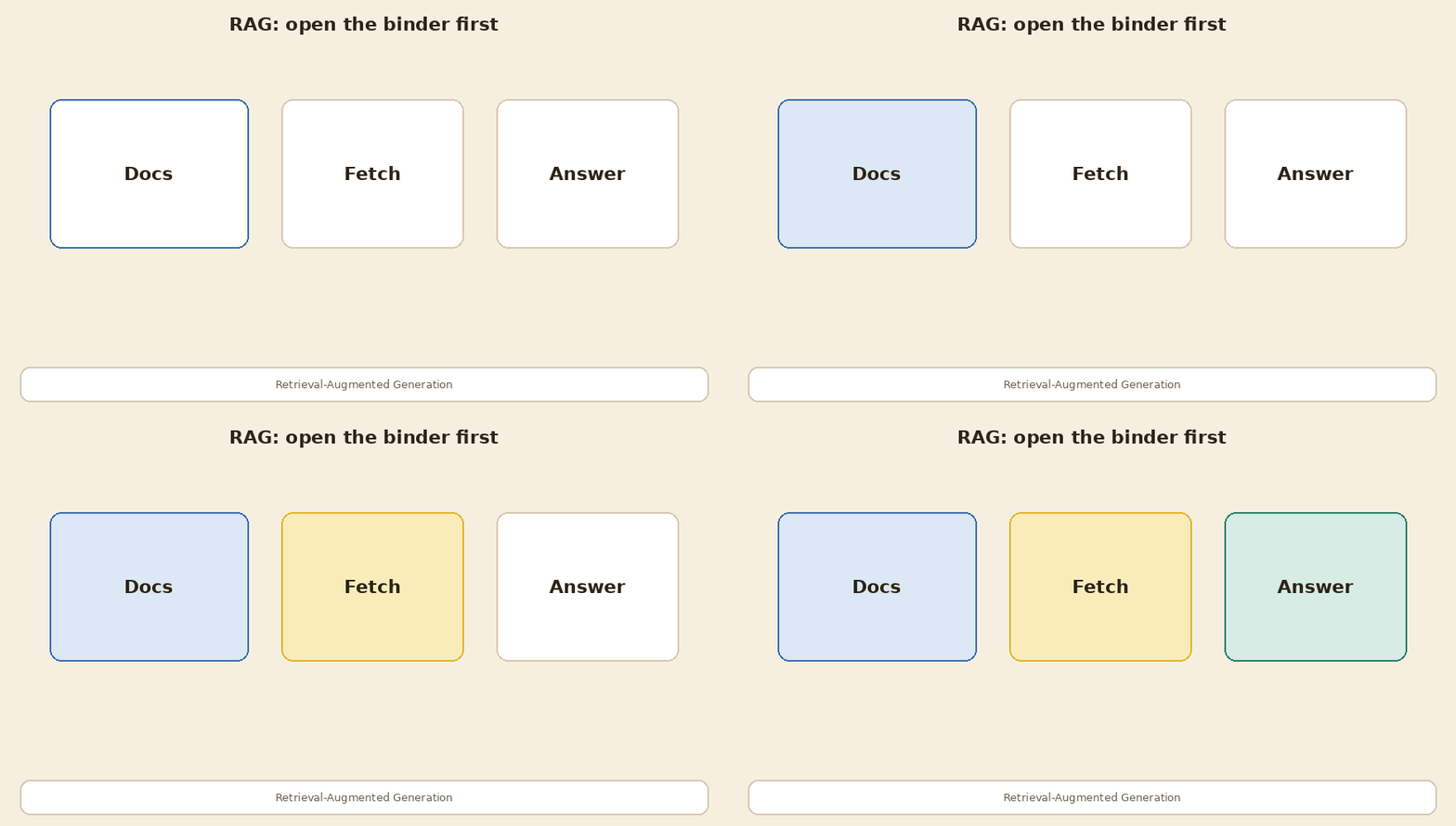
Simple picture: open-book test. Grab three photocopies from the binder, then write. Closed-book is hoping you memorised the binder.
What “RAG” means in a shipping app (same sandwich, different bread):
- Retriever: BM25, embeddings, hybrid. Index: files, tickets, wikis — your corpus, not only Wikipedia.
- Generator: any decoder / chat model. The 2020 paper is seq2seq; 2024 is usually a prompt template.
- The failure modes stayed: bad chunking, stale index, retrieved junk, generator ignores the notes.
This site’s listed piece Semantic caching is about not repeating similar questions. Different knob. Same lunch-box neighbourhood.
Why it mattered / what it unlocked
- The usual engineering answer to hallucination. Not a cure. A control surface: documents, chunking, eval on your questions.
- Provenance. Even a sloppy citation (“we used paragraph 4”) beats a bare next-token shrug.
- A named origin. People said “memory nets” and “open-domain QA” before 2020. RAG is the paper most product decks mean.
- It does not replace fine-tuning. LoRA changes habit. RAG changes what notes are in reach. Use both when you need both.
In a real stack
A shipping RAG service is usually four boring pieces:
| Piece | What goes wrong |
|---|---|
| Chunking | Too big → retrieval is mush. Too small → no sentence of context |
| Index + metadata | You forgot to filter by tenant, language, or “do not use” |
| Prompt template | “Use the notes” is weaker than “if the notes do not say, say you do not know” |
| Eval set | Ten golden questions with the passage you expect. Without this you are guessing |
You can swap the 2020 BART generator for any hosted chat model. You cannot skip the index quality.
What to remember
- Retrieve → condition → generate. Two memories.
- The 2020 corpus is Wikipedia passages. Your product corpus is whatever you index.
- Updating docs is the cheap fact fix; retraining a 70B is not.
- If the retriever misses, the generator cannot honestly know.
- “RAG” on a slide is this box even when the generator is a hosted chat API.
When to read the real paper
Open Lewis et al. when you want:
- the RAG-Sequence vs RAG-Token combination rules
- Natural Questions / TriviaQA / FEVER-style numbers vs closed-book seq2seq
- how they train retriever + generator together
- the original FAISS + DPR + BART bill of materials
Skip the grind if you only needed “open the binder, then speak.”
Links
- Paper — Lewis et al., arXiv 2005.11401
- Retrieval corpus: Wikipedia dumps (the paper indexes Wikipedia passages)
Back on the tray: lunch-box map · cheap habit LoRA