The Intelliwise — lunch-box note
PEFT — longer guide
The family name for cheap fine-tuning: change a few extra numbers, not a second copy of the model.
This is the family page in the cheap-tuning box on the lunch-box map. Not one paper. PEFT = Parameter-Efficient Fine-Tuning. LoRA is the member you should default to. This page is the roster.
What problem it solves
The library building stays put. Each new subject gets a thin pamphlet, not a second building.
You have a strong pretrained model and a real task set. Full fine-tuning works and is wasteful: you store and train all weights, once per skill. PEFT methods specialise the model by training a small add-on (or a small slice of weights) so one frozen backbone can wear many skills.
| Use PEFT when | Do not start with PEFT when |
|---|---|
| You can train (you have weights, a GPU, a dataset) | You only have a closed API key |
| Prompting / RAG keep missing a habit | The missing facts live in documents — try RAG first |
| You want several specialists of one base | You need a one-off answer (that is a prompt) |
How the idea works
Same job as a full fine-tune: move the model toward your distribution. Different where the new numbers live.
flowchart TB
  B[frozen backbone] --> L[LoRA sticky notes]
  B --> A[adapter bottlenecks]
  B --> P[soft prompts / prefixes]
  L --> S[specialist skill]
  A --> S
  P --> S
A short family tree (honest, not complete):
- Adapters (Houlsby et al., 2019). Tiny bottleneck layers slid inside a frozen BERT (down-project → nonlinearity → up-project). Early, clear PEFT. Extra depth at run time unless you get clever.
- LoRA (Hu et al., 2021). Low-rank update beside a frozen linear map. Mergeable. Today’s default. Own guide.
- Prompt / prefix / P-tuning. Do not touch the backbone internals. Learn extra vectors that sit in the input (or in every layer as a prefix). Great when you want a light touch; often weaker than LoRA for heavy style/tool habits.
- BitFit, IA3, and friends. Even smaller slices (biases only, or learned rescales). Know they exist. Do not start here.
- QLoRA (later). Same LoRA maths, 4-bit frozen base so a bigger model fits. Not a 2019–2021 landmark on this tray; you will meet it in tools.
Hugging Face PEFT is the library most engineers import. It is not a paper. It is the drawer where these pamphlets live.
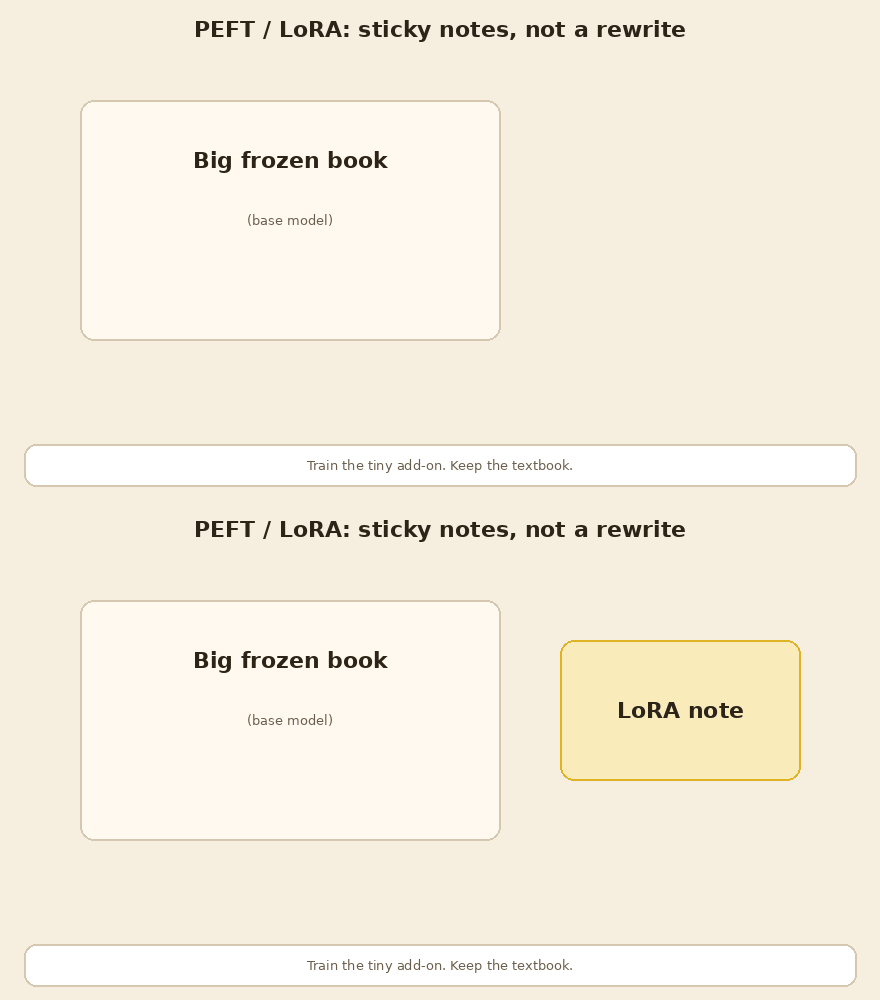
Simple picture: plugins. The app binary stays. You drop in a small module per customer.
Why it mattered / what it unlocked
- Budget maths. Seventy billion weights × N customers does not fit a disk or a procurement meeting.
- Hot-swap skills. Train overnight, ship a few megabytes, leave the base checkpoint where it is.
- A shared vocabulary. “We did PEFT” is now a sentence in design docs. Push for the method name.
- Adapters were the proof. Houlsby et al. showed BERT + tiny inserts ≈ full fine-tune on GLUE-style work. LoRA later won the LLM era on simplicity + merge.
Deeper tour of knobs (rank, alpha, QLoRA): PEFT, LoRA, and QLoRA on this site. That post is a listed Writing piece. This page stays a lunch-box satellite.
What to remember
- PEFT is a family, not a single algorithm.
- Default: LoRA. If the base will not fit, QLoRA. Else, know why.
- Houlsby adapters = early bottleneck inserts, especially on BERT-era encoders.
- HF PEFT = the import path, not the citation.
- If the knowledge is in files, retrieval is cheaper to iterate than a training run.
When to read the real papers / docs
- Library you will actually click: Hugging Face PEFT — configs, supported methods, how adapters attach.
- Houlsby et al. when you want the original adapter diagrams and GLUE-style tables.
- Hu et al. when you want the LoRA maths (see the LoRA guide).
Skip a full-family survey if you only needed “cheap specialise; start with LoRA.”
Links
- Hugging Face PEFT docs
- LoRA paper — Hu et al.
- Adapter paper — Houlsby et al., arXiv 1902.00751
- PMLR / ICML version
- Google Research page
Back on the tray: lunch-box map · LoRA